

On the Saint-Louis shoreline, at Mont-Dore, tonnes of ore had lain in storage for years, remnants of old workings that no one was any longer accountable for. Between 2009 and 2011, Groupe MAI set out to close this chapter: to remove the ore, reprocess it and give the shore back a redeveloped face.
More than ten years after its completion, this project remains one of the most telling in the group's history. Better than any long speech, it conveys a certain idea of the miner's trade: leave nothing behind, and turn a liability inherited from the past into a resource for the present.
The case of orphan mines
Mining has long shaped the landscapes and the economy of New Caledonia, and not every page of that history was written with the same care. Sites worked in the past were sometimes left as they were, at a time when the requirements for site restoration lacked the precision they have today. The profession has a name for these situations: orphan mines. Sites marked by past mining activity, with no identified operator to carry out their restoration — no one to turn to, no budget to act, no timetable to hope for.
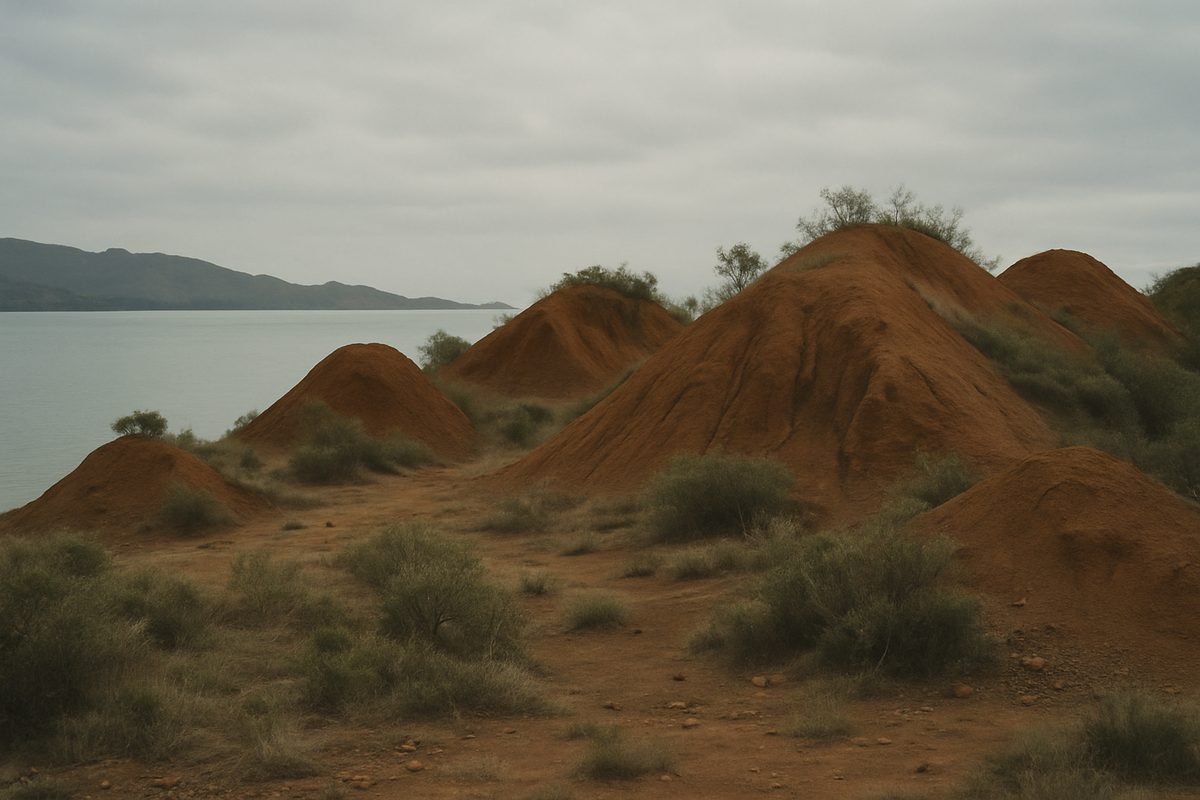
The Saint-Louis stockpiles offered a concrete illustration of this: ore that had been extracted and then abandoned, cluttering the shoreline with no prospect of recovery. As early as July 2009, the local press was reporting a possible removal of these tonnes of ore. 'The tonnes of ore could finally move out of Saint-Louis,' headlined Les Nouvelles Calédoniennes on 22 July 2009 — and that 'finally' said it all: hardly anyone still imagined that these stockpiles would ever move.
For Groupe MAI, whose first acquisition of its own mining titles in N'Go Bay dates back to 1994, this project stemmed from a simple conviction: ore that has already been extracted must not be left abandoned.
Why a miner takes on stockpiles left by others
One might be surprised that an operator would devote two years to stockpiles it did not build up. The answer lies in three words: proximity, know-how, markets.
Proximity, first: established on its titles in N'Go Bay, at Mont-Dore, the group is the direct neighbour of this shoreline and its inhabitants. Know-how, next: taking back an old stockpile, sorting its material and checking its grades is miner's work, which the teams carry out daily on their own sites. Markets, finally: without customers able to absorb low-grade ore, destocking would remain an expense with no return; with them, it becomes an operation that itself funds the cleanup of the site.
It is the combination of these three assets that made it possible to close the Saint-Louis file, where it would otherwise have remained open indefinitely.
Two years to remove and reprocess
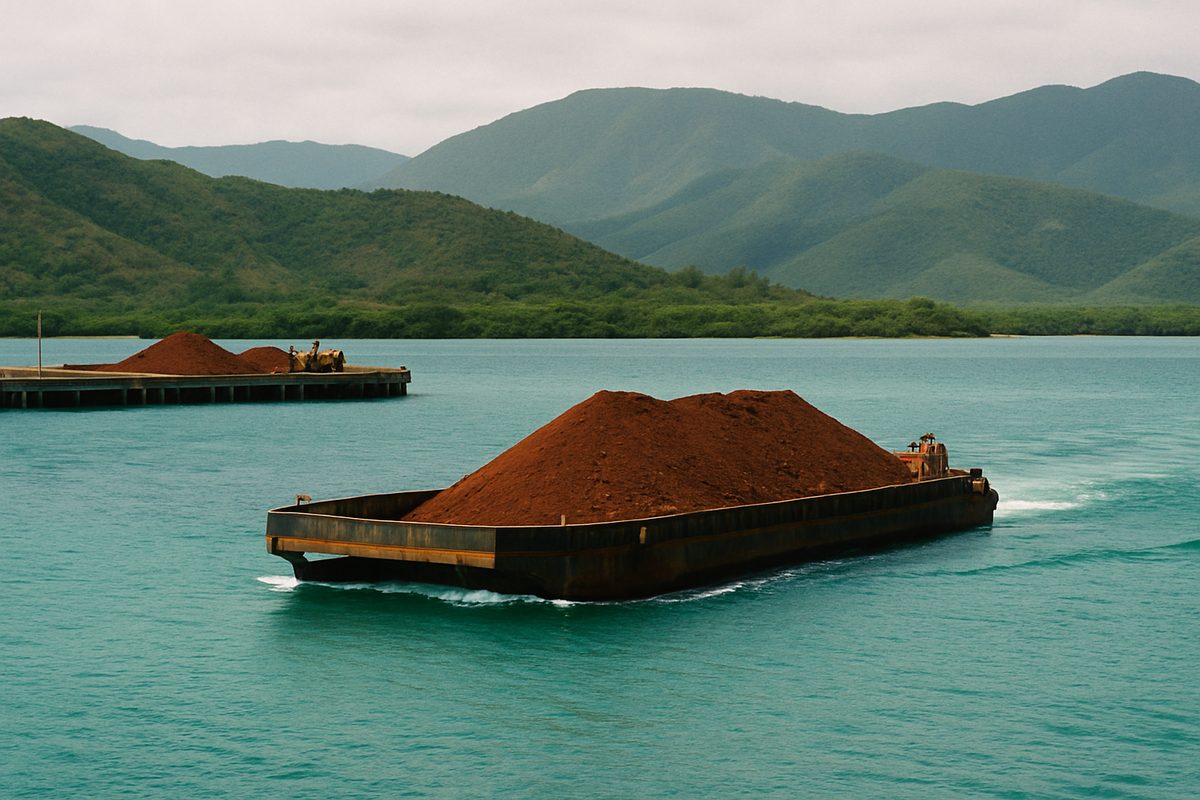
The operation took place between 2009 and 2011. The ore was removed from the shoreline, then reprocessed and reintroduced into the recovery circuit. In April 2011, Les Nouvelles Calédoniennes reported the departure by sea of this long-neglected ore, under a headline that on its own summed up the distance travelled: 'The abandoned ore puts to sea'.
To reprocess, in this context, is to give market value back to a material that everyone considered lost: taking back the stockpiles, preparing them, checking their grades, then returning them to the commercial circuit on the same footing as freshly extracted ore. It is miner's work in its own right. On its sites, the group systematically applies this quality control: each batch is sampled and then analysed in the laboratory, and the ore is dried before shipment.
A few milestones:
- July 2009: the prospect of removing the Saint-Louis stockpiles is raised publicly.
- 2009-2011: removal and reprocessing of the old shoreline stockpiles.
- April 2011: the abandoned ore leaves the shore by sea.
- 2011: the Ada mine obtains its operating order, a sign of the return of mining to Mont-Dore.
Behind these dates lies the reality of a long-haul project: taking back the stockpiles with machinery, transporting them, preparing them batch after batch, then arranging their departure by sea. Two years of methodical work to erase long years of neglect — and, in the end, a shoreline freed of its heaps of ore.
Redeveloping: the shore's second life
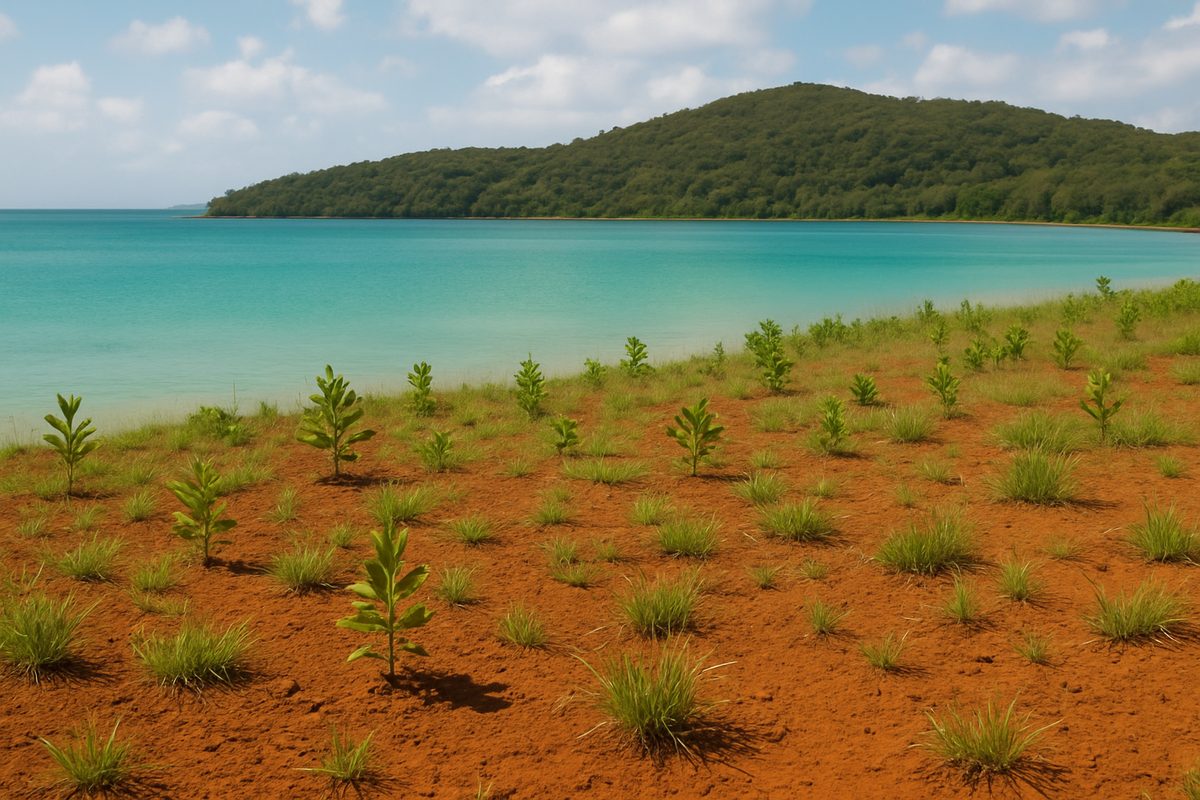
The stakes, however, went beyond mere removal. The clearance was also 'an opportunity [...] to redevelop the area', the group's environmental manager stressed at the time in Les Nouvelles Calédoniennes, in 2011. Destocking thus becomes a tool for cleanup: once the stockpiles are gone, the shoreline can find another future.
That is the whole difference between moving a problem and solving it. A stockpile of ore abandoned on a shore is a barren footprint, a blot on the landscape and a burden no one claims. Removing it with no further plan would amount to shifting the question; removing it to recover the material and redevelop the site is settling it. For the group, taking away the old stockpiles, recovering them and restoring the site is part of the miner's trade on the same footing as extraction itself.
This conception of the trade does not stop at the Saint-Louis shoreline: water management on the waste-rock dumps, maintenance of the structures that protect the environment, certified practices — it runs through all of the group's activities, detailed on our Environment page.
A partnership with the public authorities and the customary authorities
These operations to destock old ores, aimed at cleaning up degraded areas, are carried out in partnership with the public authorities and the customary authorities. This is the method the group applies to the orphan-mine situations in which it intervenes.
This twofold dialogue is not a formality. The public authorities regulate, authorise and oversee; the customary authorities carry the voice of the communities for whom this shoreline is not simply a piece of land, but a place of life and memory. To conduct a project of this kind without either party would make no sense: it is together that the restoration of a site finds its legitimacy.
At Saint-Louis, this dialogue rests on concrete ties. The shareholders of the company Wakondé, created with MKM, come for the most part from the tribes of Saint-Louis and Île Ouen. Wakondé handles the loading of the ore carriers in N'Go Bay and mobilises ten to fifteen casual jobs at each operation, under MKM's responsibility. The partnership formed around destocking is thus part of a broader relationship, in which local people are at once neighbours, partners and economic stakeholders in the mine.
These ties did not begin with the destocking project, nor did they end there. Since its beginnings, the group has cultivated lasting partnerships with customary chiefs, local communities, institutions and the communes near its sites: this is, together with the field know-how built since the late 1950s, one of the two keys to its journey.
Low grade, a resource economy
To reprocess an abandoned stockpile is to recover an ore that others judged to have no future. Groupe MAI has made it one of the strands of its strategy: the recovery of low-grade ores and historic stockpiles, at Saint-Louis as in N'Go Bay. In 2024, NC la 1ère again praised this resource-economy model, which has become one of the group's hallmarks.
A word of explanation is in order. In the mining massifs, not all ore is equally rich: the laterites, located in the upper layers, have a lower nickel grade than the deeper saprolites. For a long time, only the highest grades found a buyer; the rest was set aside, stockpiled, forgotten. To recover the low grade is to make this downgraded material a resource in its own right — and the old Saint-Louis stockpiles were the very example of this.
There still have to be markets, though. On the group's mines, the saprolites are destined for Japan, Korea and the Doniambo plant; the laterites go to China and Australia. In 2013, MKM signed a ten-year contract with Japan's Pamco for 250,000 tonnes per year, 'the company's biggest contract' according to the press of the time. In 2015, out of four export applications to China, MKM alone obtained the government's green light; the ore carrier Eternal Triumph, with a capacity of 55,000 tonnes, arrived in N'Go Bay at the end of that same year, and exports to Japan and Australia were approved in short order. In 2019, the Conseil d'État definitively confirmed these authorisations. In 2024, the group exported 215,000 tonnes of ore to China and Korea.
This resource economy rests on a simple idea: everything that has been extracted deserves to be recovered, and every tonne recovered is a tonne that does not need to be extracted elsewhere.
Saint-Louis is, moreover, not the only place where this strategy applies: it also holds for the historic stockpiles of N'Go Bay, which the group integrates into its operations. The shoreline project is therefore nothing of a one-off; it is the most visible expression of a way of thinking about the resource that runs through all of the group's activity.
The return of mining to Mont-Dore
The Saint-Louis project is not an isolated episode: it accompanies the return of mining to Mont-Dore, conducted by the book, step by step. A mine is not improvised: exploration permit, studies, public inquiry, then an operating order issued by the authorities mark out the path of any project.
On the group's titles in N'Go Bay, this path unfolded methodically:
- Ada: prospected in 2008 and 2009, rehabilitated and brought into extraction from 2010 on its South and North plateaus, it obtained its operating order in 2011 — the very year the Saint-Louis project was completed.
- Graziella: subject to a public inquiry in 2015, it has been in operation since 1 April 2016.
- Mireille: under exploration permit.
The case of Ada is worth pausing on: before resuming extraction there, the group first rehabilitated this old mine. Repair before mining — fundamentally the same approach as on the Saint-Louis shoreline at the same time. As for Graziella, its file followed the entire regulatory path, public inquiry included, before coming into operation.
These three mines bear the first names of three of the daughters of Jules and Émilienne Mai, the founders: a way of recalling that the direct operator of N'Go Bay remains a family business, born in 1984 under the name Maï Kouaoua Mines and whose New Caledonian history begins in 1956 at the Kouaoua mining centre.
The detail of this path, from the administrative authorisations to the loading of the ore carrier, is presented on our Mining and sustainable development page.
What remains of the Saint-Louis project
From this project completed in 2011, there remains first a shoreline rid of its stockpiles, and an area whose redevelopment could be set in motion. There remains, next, a method, applied ever since to every comparable situation: bring in the public authorities and the customary authorities, recover the material rather than move it, and restore the site once the work is done.
There remains, finally, a conviction, handed down within a family business that has mined for several generations: the mineral resource is not inexhaustible, and respecting it begins with wasting none of it — not even the stockpiles that others had abandoned.
Fourteen years after the Saint-Louis project, the same logic guides the teams' daily work: mine with care, rehabilitate what must be rehabilitated and leave nothing behind.
