

New Caledonian nickel first brings to mind the large metallurgical plants. Yet the industry also rests on a fabric of independent mining companies, those known here as the 'small miners', who extract ore and export it to the smelters of the Pacific and Asia. Groupe MAI belongs to this family of players, and its journey illustrates what they bring to the country.
Small miners, hauliers, contractors: who are we talking about?
The vocabulary of New Caledonian mining is worth setting out, because on its own it tells the story of an entire way of organising the work:
- metallurgists operate plants that transform ore into metallurgical products;
- independent miners, the 'small miners', hold their own mining titles, extract ore and export it raw to smelters, in New Caledonia or abroad;
- contractors run the operation of a site on behalf of another operator, who remains the holder of the mining title;
- hauliers carry the ore, from the working faces to the stockpiling platforms and the wharf.
The word 'small' should not mislead: it simply sets these companies apart from the metallurgical operators, and says nothing about their real weight in the country's economy. What sets Groupe MAI apart is that it has practised all these trades — haulier, contractor, then direct operator — often at the same time, which makes its journey particularly representative of this family of players.
This longevity has placed the group among those that count. It was one of the six historic exporters of ore to Queensland Nickel, in Australia, alongside Ballande, the SLN, the NMC, Montagnat and Gemini. In 2023, NC la 1ère still referred to it as the 'fourth-largest New Caledonian miner' among the players interested in the QPM plant project in Townsville, Australia.
A profession organised since 1989
Since 1989, this family of players has had a common house: the Syndicat des industries de la mine (SIM), affiliated with MEDEF-NC, which brings together the nine New Caledonian nickel industrialists — the metallurgists SLN, KNS and Prony Resources, the SMSP, the NMC, the SMT of the Ballande group, the SMGM of the Montagnat group, Gemini and MKM (Maï Kouaoua Mines), the group's mining company. This framework gives the small miners a full voice in the industry's debates.
Wilfrid Mai (1961-2024) chaired the union from 2013 to 2024, re-elected in 2016 and in 2020: eleven years at the head of the profession, a sign of the recognition granted to family operators. In 2019, the profession also named him honorary chairman of Contrakmine. On his passing, on 5 October 2024, the SIM paid tribute to an 'emblematic figure of the mining sector' (statement of 5 October 2024), and the government of New Caledonia honoured him with an official statement.
This past February, the SIM launched C'Nickel, an educational campaign rolled out on the cnickel.nc platform to explain nickel to the general public in simple terms: thirteen themes covered in short video capsules, supplemented by fact sheets and quizzes. As a member of the union, the group is fully committed to this approach, as we reported at the time of the launch.
From haulier to direct operator
The group's history sums up the journey of New Caledonia's small miners, and it begins well before any company was ever founded.
The Pentecost years, learning the trade
Having arrived from Tahiti in 1956, Jules Mai joined the Kouaoua mining centre, within the Pentecost Mining Group. He was first a storekeeper, then a salesman and manager of the spare-parts store. In the early 1960s, he married Émilienne Tehei Boewa, originally from Nindhia, in Houaïlou; assigned to the assay laboratory, he bought two trucks and hauled ore on the Pentecost mines of Houaïlou. Between 1968 and 1970, he delivered 6,000 tonnes of ore enriched to 2.60% and took charge of all Pentecost prospecting. In the 1970s, he carried out five years of itinerant prospecting across the whole of Grande Terre, most often on foot, the children growing up to the rhythm of the camps. 'We were born in the dust,' Wilfrid Mai summed up, according to Les Nouvelles Calédoniennes of 04/06/2013.
Subcontracting, a demanding school
In 1984, after thirty years at Pentecost, Jules Mai founded MKM; Wilfrid, the eldest son, was already working on the mine. The company first worked for others: the Sireis mine at Népoui for the SLN from 1989, direct-labour works on the Kiel Méa mine, at Kouaoua, from 1999 to 2010, then, from 2000, the Poro site at Houaïlou with the SMP (Société Minière de Poro), contractor to the SLN on the Bonini mine. From late 2000, the SMP produced laterites exported to Australia; in 2005, it began producing saprolites destined for the Doniambo plant. Its contract-mining agreement was renewed without interruption for more than twenty-two years: a trust earned site after site, through the quality of the work delivered.
1994-2016: titles of its own
The turning point came in 1994, with the first acquisitions of mining titles in N'Go Bay, at Mont-Dore. The Ada mine, prospected in 2008 and 2009 and then brought into extraction in 2010, obtained its operating order in 2011: its reopening marked the return of mining to Mont-Dore. The Graziella mine came into operation on 1 April 2016; the Mireille mine is the subject of an exploration permit. With its own titles, the group became a direct operator, a journey unique in the country. A telling detail of the family spirit: the three mines bear the first names of three of Jules and Émilienne's daughters. This seventy-year saga is told in detail on this site.
The full trade, from mine to ore carrier
Being a small miner is not only about extracting ore: it means mastering a complete chain of operations, regulated and monitored at every stage. On the group's sites, it unfolds as follows:
- geological monitoring and management of the working faces;
- extraction of laterites and saprolites, with controlled placement of waste rock in dumps, from drainage to compaction by way of profiling and water management;
- grade control: sampling of each batch, laboratory analyses, drying of the ore by turning before shipment;
- haulage and stockpiling: the ore is moved to the platforms, then carried to the wharf;
- loading of the ore carriers: mooring (line-handling) services, barging and operation of the shipboard cranes.
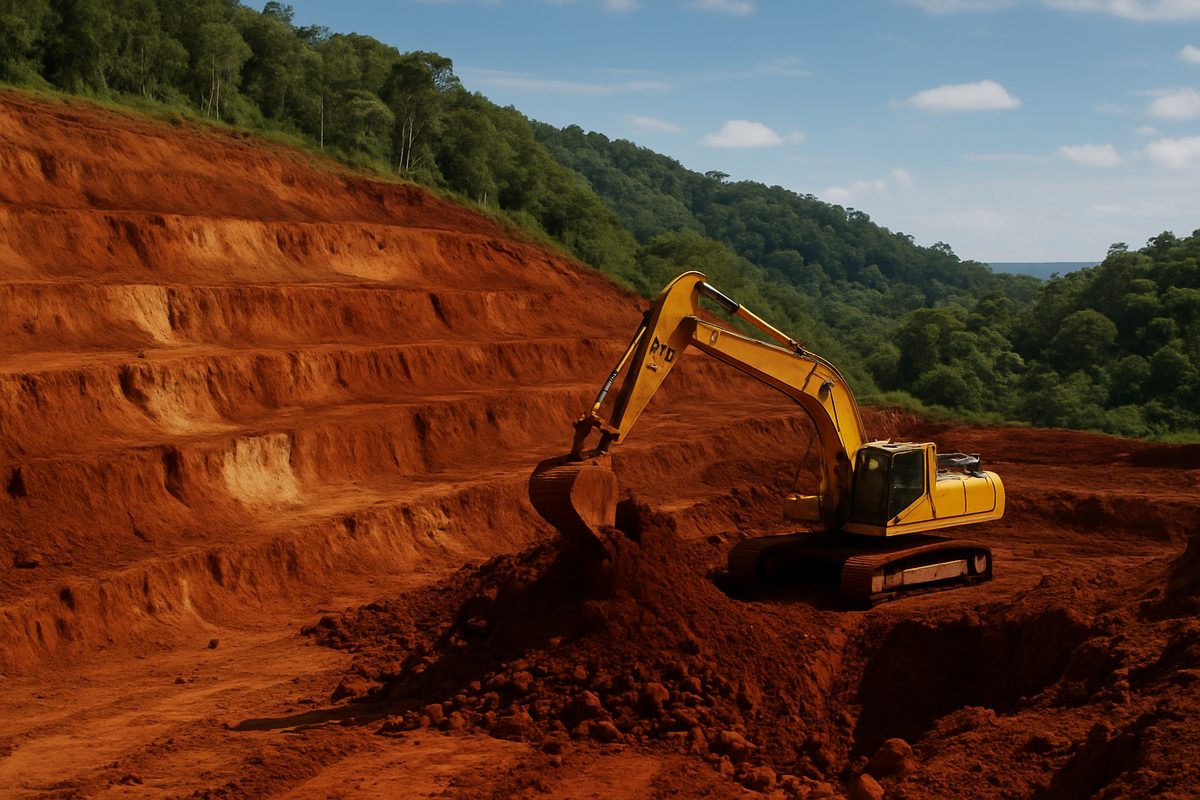
Two families of ore come out of these operations, and each has its markets: the saprolites go to Japan, Korea and the Doniambo plant; the laterites to China and Australia.
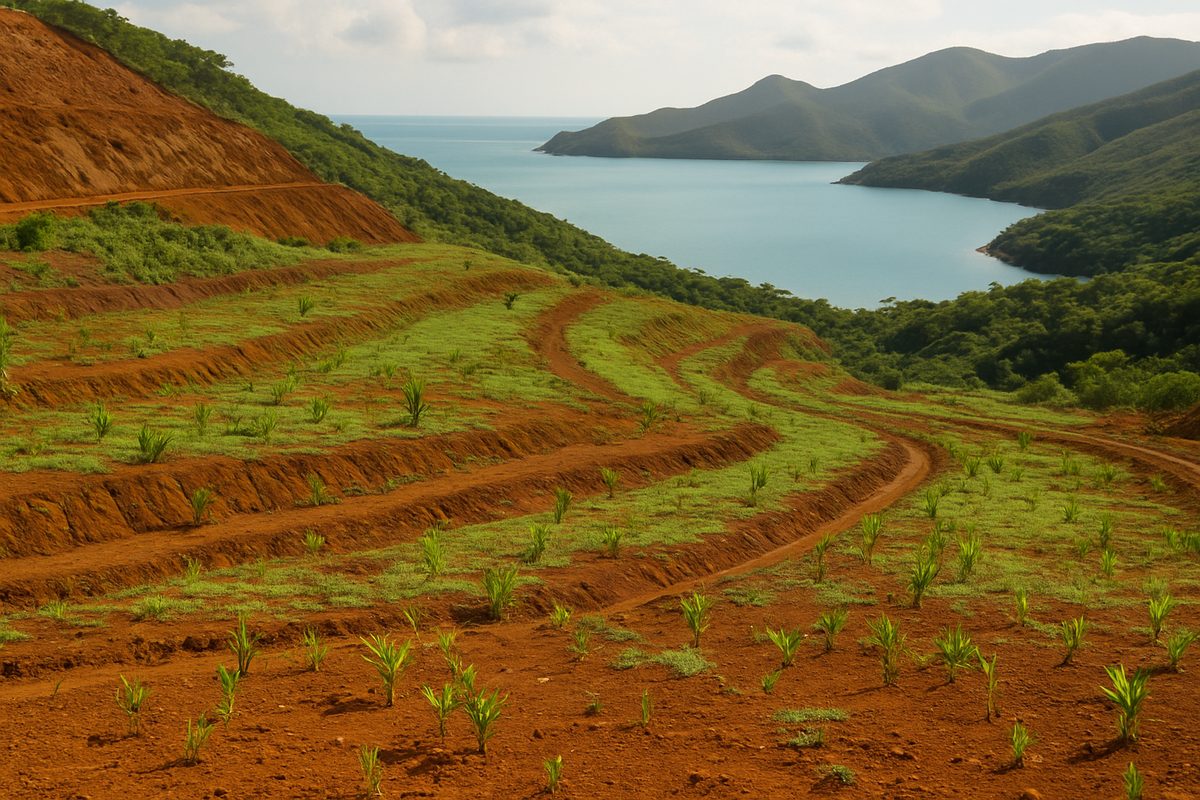
Finally, the trade includes a lesser-known dimension: the recovery of low-grade ores and historic stockpiles — creating value from what has already been taken out of the ground. This is how the old stockpiles accumulated on the Saint-Louis shoreline were removed and then reprocessed between 2009 and 2011, an operation that was also 'an opportunity [...] to redevelop the area', according to the group's environmental manager (LNC, 2011). For a small miner, resource economy and rehabilitation are as much a part of the work as extraction itself.
This know-how is exercised on two fronts. As a direct operator, on the group's mines in N'Go Bay. And as an operator on behalf of the SLN at Poro, where the SMP has handled the complete chain since 2000: 420,000 tonnes loaded in 2022, a target of 500,000 tonnes, and around 5 million tonnes produced and loaded between 2012 and 2025, with more than 80 mining machines, a fully equipped workshop and a dock. About 80% of this production is exported, the rest feeding the Doniambo plant. SLN, on whose behalf the SMP operates, is also ISO 14001 certified for environmental management and ISO 45001 for occupational health and safety; the SMP works under this coverage and upholds its standards: among small miners too, practices are audited and measured.
Exports built to last
In 2013, MKM signed a ten-year contract with Japan's Pamco for 250,000 tonnes per year, the largest in its history. In 2015, out of four export applications to China, MKM alone obtained the government's green light; the ore carrier Eternal Triumph, a 55,000-tonne vessel, arrived in N'Go Bay at the end of that same year to inaugurate this new market. Exports to Japan and Australia were approved in December 2015, then definitively confirmed by the Conseil d'État in 2019.
The group's reach extends, moreover, beyond New Caledonia alone. As early as 2014, together with China's JinPei it was developing a pyrometallurgical plant project in Vanuatu, described by the press of the time as 'one of the country's biggest industrial projects since its independence'.
In 2024, 215,000 tonnes put to sea bound for China and Korea. Last year, the authorisations were renewed for the long term: until January 2031 to Glencore and until April 2035 to Pamco, with export capacity restored to 450,000 tonnes. Such horizons give visibility to the business and to jobs alike.
Exporting, lastly, does not preclude innovation. In November 2025, MKM chartered L'Afros, a hybrid ore carrier fitted with four wing sails — the first New Caledonian charter of a wind-powered ore carrier — loaded in N'Go Bay and visited on that occasion by the president of the government of New Caledonia and the mayor of Mont-Dore. A small miner can also lead the way.
An ecosystem that sustains the territory
The strength of the small miners also lies in what they draw along in their wake:
- thirteen independent hauliers have worked alongside MKM since 2010, the growth of activity in N'Go Bay having also enabled the creation of several local haulage companies;
- the group's lighterage operation, self-sufficient since January 2013, fields two tugboats — Le Jules and L'Émilienne, named after the founders — five 500-tonne barges and one 600-tonne barge: around 1 billion CFP francs invested and ten sailors directly employed;
- the company Wakondé, the majority of whose shareholders come from the tribes of Saint-Louis and Île Ouen, handles the loading of the ore carriers, providing ten to fifteen casual jobs per vessel;
- the SMP is the leading employer in the commune of Houaïlou, with 66 permanent employees, joined by 8 haulage subcontractors and 14 casual workers on average.
In 2026, the N'Go Bay mines account for 80 direct jobs, 20 subcontractors and 10 casual loading workers; as early as 2016, the group estimated at 200 the number of people living from its mining activity. Across the group as a whole, more than 150 employees carry the business in 2026.
The passing on of know-how is part of the same movement: at the Poro training centre (CFTMC), of which the SMP was a partner, the 2006 cohort graduated 42 machine operators, including 19 women. The Ada and Graziella mines also regularly open their tracks to school groups — as was the case in 2014 and again in 2021: showing the trade to the youngest is preparing the next generation of an entire industry.
This local anchoring finally runs through community commitments, in keeping with the lasting partnerships the group maintains with customary chiefs, local communities, institutions and the communes near its sites. In 2019, MKM signed with the commune of Mont-Dore an agreement to maintain a section of the Route du Sud. And when Cyclone Pam struck Vanuatu, in 2015, the family made a tugboat and a barge available free of charge to carry 600 tonnes of donations — including 20 tonnes of rice — and six construction modules. 'The Mai family wished to make its contribution,' Christian Taupua explained at the time (Les Nouvelles Calédoniennes, 17/06/2015).
A place won in the field
From the N'Go Bay wharf to the smelters of Japan, Korea or China, this chain illustrates the place of the small miners in New Caledonian nickel: a place won in the field, which Groupe MAI intends to keep holding. The family tradition endures, moreover, with the entry of Jules and Émilienne Mai's grandchildren into the group's various companies, faithful to the house motto: 'IL FAUT TRAVAILLER !'.
