

A New Caledonian first in N'Go Bay
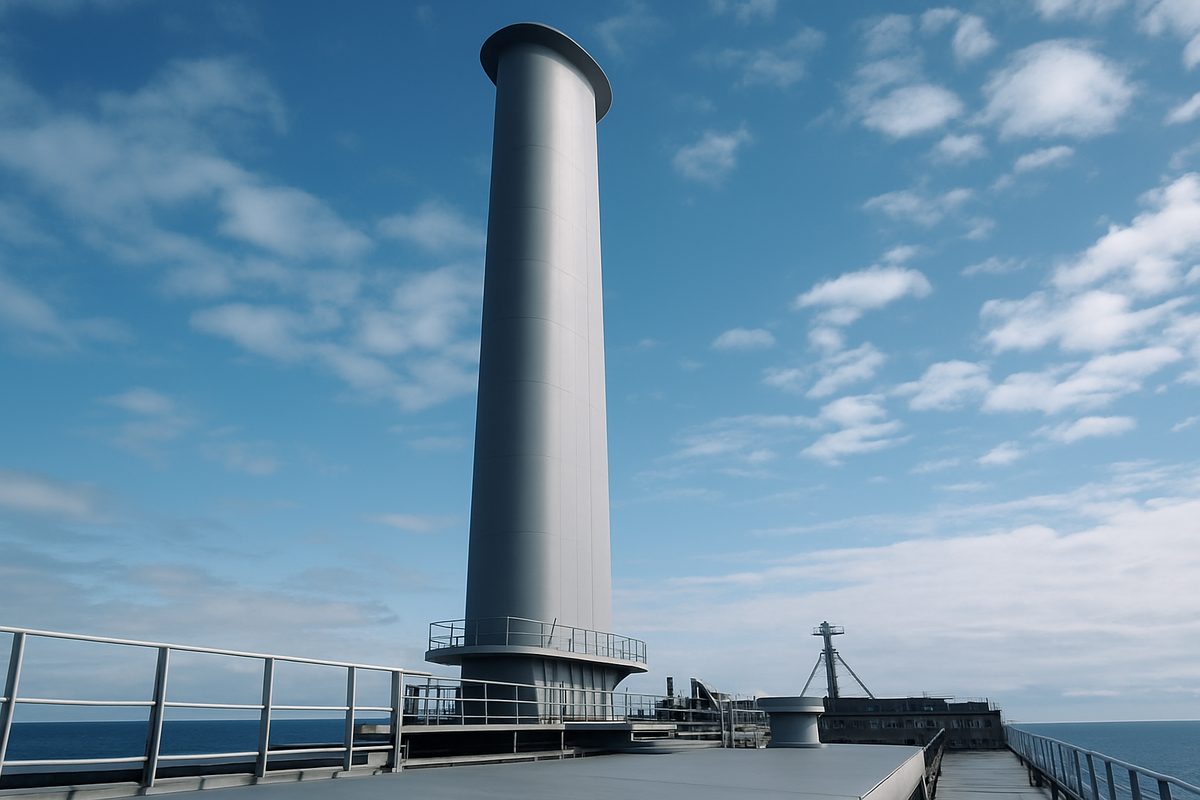
In early November, the Afros reached N'Go Bay, in Mont-Dore, to load nickel ore extracted from the group's mines. At first glance, a loading operation like the ones MKM has run regularly from its wharf for years. With one detail: four turbosails stand on the ship. The Afros is a hybrid ore carrier, fuel-oil propelled and wind-assisted, and its charter by MKM is a first for a New Caledonian mining operator. Les Nouvelles Calédoniennes devoted an article to the event on 4 November 2025.
The scene is striking. The ore carriers that anchor in N'Go Bay are usually conventional bulk carriers, their silhouettes all alike. That of the Afros, bristling with its four turbosails, stands out: it looks like a ship from another era — or rather from the next. For wind propulsion, which powered every ship until the age of steam, is making its return in world shipping today, in entirely rethought forms.
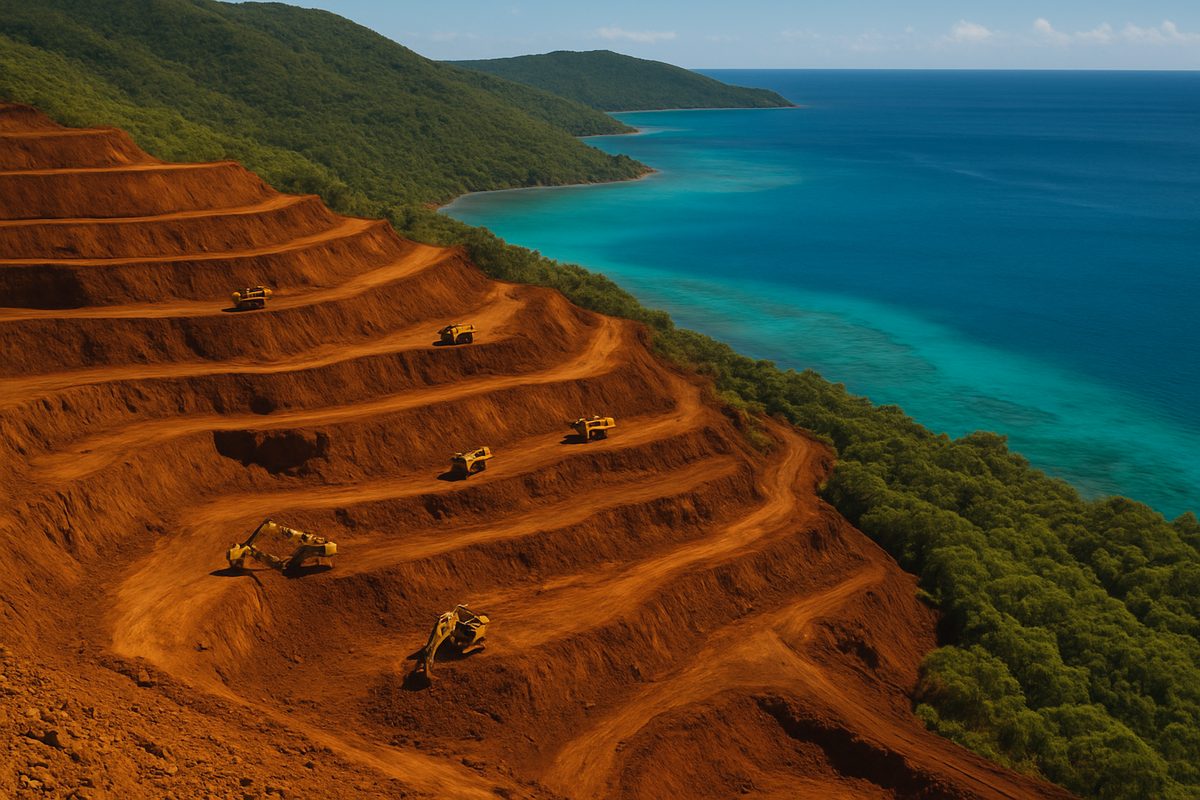
The setting, for its part, is familiar to the group's teams. N'Go Bay, in Mont-Dore, is the home port of MKM's mining activity: this is where the Ada and Graziella mines are located, it is from its wharf that the ore leaves for the ore carriers, and it is here that the group's lighterage fleet operates day in, day out. To see a maritime innovation of this scale choose N'Go Bay for its first New Caledonian loading is to see the group's long-term work meet the global news of shipping.
What is a turbosail?
Behind this name lies an old principle brought up to date: using the wind as a driving force. Unlike a canvas sail, the turbosail is a rigid vertical structure, installed on the deck, that generates thrust from the wind met at sea. Adjusted according to sailing conditions, it supplements the main propulsion: the ship remains a motor ship, but a ship that the wind helps to move forward. No rigging manoeuvres, no additional crew aloft — technology has turned the sail into an industrial piece of equipment.
The operation in brief
- The ship: the Afros, a hybrid ore carrier combining fuel-oil propulsion with four turbosails;
- The place: N'Go Bay, in Mont-Dore, where MKM loads its ore from its wharf;
- The date: early November 2025;
- The first: no New Caledonian mining operator had yet chartered a wind-powered ore carrier;
- The visit: Alcide Ponga, President of the Government of New Caledonia, and Élizabeth Rivière, Mayor of Mont-Dore, came aboard.
The wind supporting the engines
The principle of the turbosails is simple: capturing the power of the wind to support the main propulsion. Less taxed, the engines consume less fuel oil, and each tonne of ore travels its sea route with a reduced footprint. For MKM, whose ore reaches Japan, China, Korea or Australia, as well as the Doniambo smelter, sea transport represents a major link in the business. Acting on the ship itself therefore means acting where the effect is most direct.
One must grasp what these routes represent. The group's saprolites head for Japan — where they notably feed Pamco, a long-standing partner — and Korea, when they do not go to the Doniambo smelter; the laterites are shipped to China and Australia. So many Pacific crossings, repeated shipment after shipment, year after year. On the scale of an ore exporter, the ship is not a logistical detail: it is the extension of the mine.
World shipping is today seeking to reduce its consumption and its emissions, and wind assistance is among the most concrete avenues: the wind is free, available at sea and perfectly clean. On regular routes such as those of New Caledonian ore, each assist from the wind is repeated on every crossing — the effect, modest over a single day at sea, becomes significant over a commercial relationship measured in years. By chartering the Afros, MKM places New Caledonian ore within this movement, and shows that it is accessible from a Mont-Dore wharf.
An official visit aboard
The significance of this first did not escape the institutions. The President of the Government of New Caledonia, Alcide Ponga, and the Mayor of Mont-Dore, Élizabeth Rivière, visited the Afros during its loading in N'Go Bay, guided by the group's management. The government published the official photos of this visit, a sign of the interest the country's authorities take in this approach.
That the President of the Government should travel aboard an ore carrier says a great deal about what this first represents for the nickel industry, a pillar of the New Caledonian economy. The presence of the Mayor of Mont-Dore has, for its part, a particular resonance: it is in this municipality that MKM revived mining, with the bringing into production of the Ada mine in 2010, then its operating permit in 2011 — the return of mining to Mont-Dore. Fifteen years later, the same municipality hosts an environmental first of national scope.
Between the municipality and the miner, the ties do not date from this visit. In 2019, MKM committed by agreement, alongside the town hall, to maintaining a stretch of the southern road. The N'Go Bay mines also regularly host school visits: middle-school students discovered the Ada mine in 2014, other pupils visited Graziella in 2021, as press coverage attests. Sites that are shown to pupils and a road that is maintained: that too is what it means to work a mine at home.
The symbol is a strong one: N'Go Bay is not only a place of extraction, it is a place where the mining trade reinvents itself.


From Ada to the Afros: three decades of building
The charter of the Afros does not come out of nowhere: it crowns a trajectory patiently built. Created in 1984 by Jules Mai — who arrived from Tahiti in 1956 and spent thirty years within the Pentecost mining group —, Maï Kouaoua Mines started out as a subcontractor, before acquiring in 1994 its first mining titles at N'Go Bay. This shift to direct-operator status changed everything: the company now runs the whole set of operations, from ore extraction to the loading of the ore carriers.
The stages then followed one another:
- 2010-2011 — the Ada mine is brought into production, then obtains its operating permit: mining returns to Mont-Dore;
- 2013 — MKM signs a ten-year contract with Japan's Pamco covering 250,000 tonnes per year, "the company's biggest contract" (local press, 2013);
- 2015 — MKM is the only New Caledonian company to obtain the government's green light to export to China; in December, the ore carrier Eternal Triumph, with a capacity of 55,000 tonnes, arrives in N'Go Bay, while exports to Japan and Australia are also authorised;
- 2016 — the Graziella mine enters operation on 1 April;
- 2019 — the Conseil d'État definitively validates MKM's exports.
Ada, Graziella, and the Mireille exploration permit: the mines of N'Go Bay bear the first names of three of Jules and Émilienne Mai's daughters, a family signature unique in the New Caledonian mining landscape. In 2024, 215,000 tonnes of ore took to the sea for China and Korea. The Afros is part of this continuity: having won its markets, the group now takes care of the way it serves them.
A logistics chain mastered from end to end
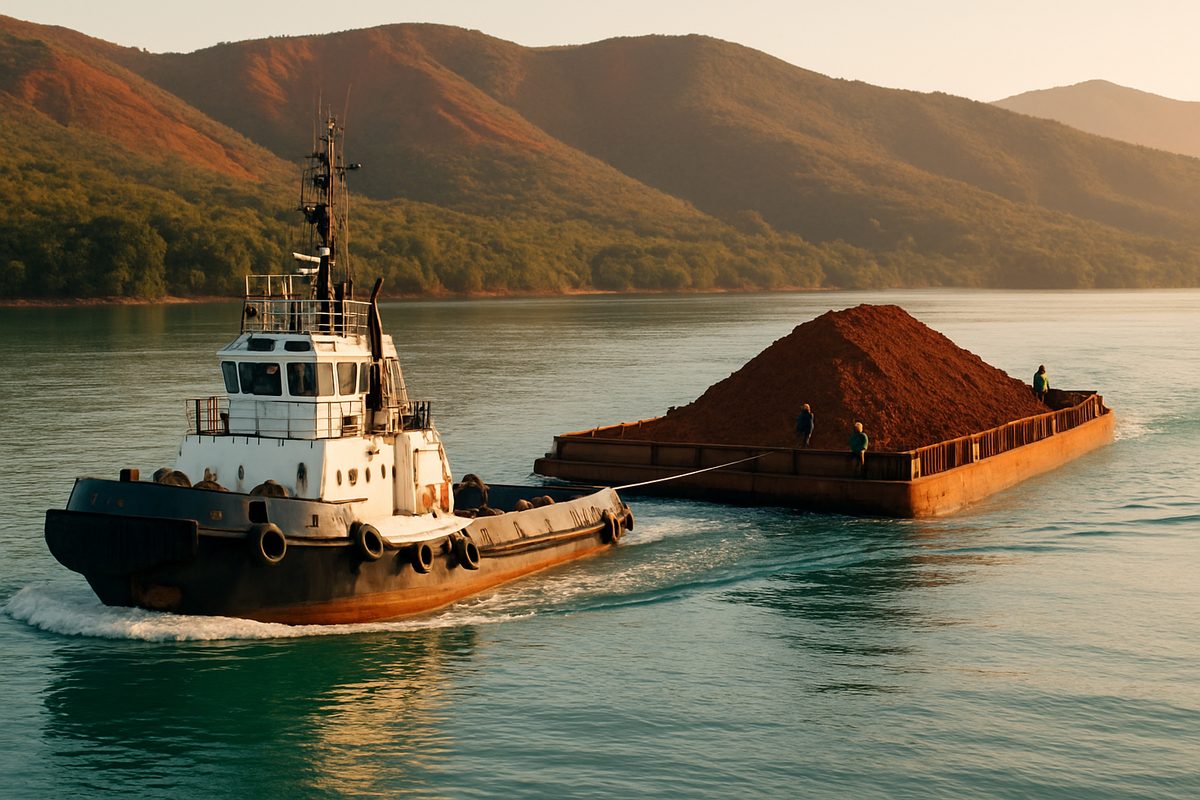
The arrival of the Afros extends an organisation that MKM has patiently built around N'Go Bay, where the group operates the Ada and Graziella mines and holds the Mireille exploration permit. Since January 2013, its lighterage operation has independently carried the ore from the wharf to the ore carriers, with in-house means:
- two 16.5-metre tugboats;
- five 500-tonne barges;
- one 600-tonne barge;
- an investment of around 1 billion CFP francs.
The two tugboats bear names that say everything about the group's spirit: Le Jules and L'Émilienne, in tribute to the founders. The lighterage operation directly employs ten people — two captains, two mates, two chief engineers qualified for 750 kW and four deckhands —, reinforced during loading by around ten casual workers.
The loading of the ships indeed mobilises the company Wakondé, created with the communities of the Saint-Louis and Île Ouen tribes: 10 to 15 casual jobs for each operation, under MKM's responsibility. The growth of activity in N'Go Bay has also enabled the creation of several local haulage companies, and independent haulage contractors have accompanied the company since 2010. As early as 2016, the group estimated at around 200 the number of people living from its mining activity.
This fleet has even shown that it can serve beyond the mine: in 2015, after Cyclone Pam passed through, the Mai family made a tugboat and a barge available free of charge to carry 600 tonnes of donations to Vanuatu, including 20 tonnes of rice. The tools of the ore trade, in the service of Pacific neighbours.
When an ore carrier like the Afros anchors in N'Go Bay, it is therefore this whole chain that is set in motion: the tugboats position the barges, the Wakondé teams board for the loading, the ore leaves the wharf and reaches the holds. A mechanism honed by years of practice, which applied to the turbosail ship exactly as it applies to conventional bulk carriers.
An environmental course held over the long term
The Afros is no isolated gesture. For several years, MKM has been recovering value from low-grade ore and legacy stockpiles: a resource-economy model, which consists of making use of material already extracted before extracting new ore. Not all ore has the same richness, and it would be easy to take an interest only in the highest grades; the group made the opposite choice, finding outlets for ores that others would have set aside. Each tonne recovered in this way is a tonne that did not have to be extracted elsewhere.
The most telling example remains the Saint-Louis shoreline: between 2009 and 2011, the old ore stockpiles that were degrading the area were removed and then reprocessed, in partnership with the public authorities and the customary authorities. An operation described as "an opportunity […] to redevelop the area" by the group's environmental manager (Les Nouvelles Calédoniennes, 2011). This type of stockpile removal contributes to cleaning up areas inherited from former operations, known as orphan mines.
At group level, the same demand is found on land: SMP, which operates the Poro mining site on behalf of SLN, works under the coverage of SLN's ISO 14001 (environment) and ISO 45001 (occupational health and safety) certifications, and upholds their standards. From water management on the spoil heaps to the choice of the ship that carries the ore, the approach is presented in detail on our Environment page.
What a first changes
A first does not only have image value: it proves the thing is possible. The Afros loaded in N'Go Bay under the real conditions of a New Caledonian ore shipment — the same barges, the same teams, the same wharf. The demonstration is made that a wind-assisted ship fits without difficulty into the logistics chain of a local miner.
That is perhaps the most lasting contribution of this operation: opening a way. The transport of ore is part of the trade of operator and exporter, and it can advance, here, in New Caledonia, from existing facilities. History will, moreover, remember this detail: it was a New Caledonian family business that, first, chartered a wind-powered ore carrier in the country. A way of recalling that innovation is not a matter of size, but of conviction.
The trade remains, the tools change
Nearly seventy years after Jules Mai's arrival in New Caledonia, the family group approaches the transport of its ore with today's tools: the mine remains the trade, the wind becomes an ally.
From the first bucketful extracted on the Ada plateaus to the turbosails standing above N'Go Bay, the thread is the same: to do the work seriously, and to do it better at each stage. This is how the group intends to keep serving its Pacific customers — with the sea for a road, and now the wind for a travelling companion.
