

An initiative driven by the whole profession
The SIM unveiled C'Nickel at Station N on 24 February 2026, a few days after announcing the campaign in a press release, picked up by MEDEF-NC and by La Dépêche de Nouméa as early as 20 February. Founded in 1989 and affiliated with MEDEF-NC, the Syndicat des industries de la mine brings together New Caledonia's nine nickel operators: SLN, KNS, Prony Resources, SMSP, NMC, SMT (Ballande group), SMGM (Montagnat group), Gemini and MKM (Maï Kouaoua Mines), the mining company of Groupe MAI. MKM holds its own mining titles at N'Go Bay, in Mont-Dore, where it has operated the Ada mine since 2010 and the Graziella mine since 2016.
From the large metallurgical plants to the independent miners, it is therefore the entire profession that is speaking with one voice. The move is rare enough to be worth highlighting: in an industry where every operator has its own history, sites and markets, the nine companies have chosen to tell the story of their trade together, rather than letting each one explain itself on its own. It was, moreover, under the interim presidency of Gabriel Bensimon (Prony Resources) that the union carried this launch: the campaign is the business neither of one man nor of one company, but of an entire profession.
C'Nickel's ambition rests on five stated objectives:
- to give everyone factual information about the industry;
- to foster a shared understanding of New Caledonian nickel;
- to calm the public debate;
- to raise the profile of mining trades;
- to provide materials useful for teaching.
La Voix du Caillou (25/02/2026) sees it as an "offensive against disinformation". Nickel does indeed hold a singular place in New Caledonian life: everyone talks about it, many make their living from it, but the concrete realities of the trade — how a mine is opened, who controls what, where the ore goes and why — often remain little known. For want of simple explanations, received ideas flourish, in one direction as much as the other. It is precisely this gap that the campaign intends to fill — not by pleading a cause, but by describing a trade as it is actually practised.
Thirteen themes, short videos and teaching sheets
At the heart of the initiative is the cnickel.nc platform, which carries a simple promise: nickel explained simply. The campaign is organised around thirteen themes, each covered by one-to-two-minute video capsules. The choice of a short format is no accident: one to two minutes is the length of a clear, jargon-free explanation that can be watched between two activities and shared easily. It is also a format well suited to the classroom: a teacher can play a capsule and then open a discussion.
These capsules are broadcast widely:
- on NC la 1ère and Caledonia;
- in the Origin and Cinecity cinemas;
- on YouTube, Facebook and LinkedIn;
- and even on board Aircalin flights.
From the family living room to the screen of a long-haul flight, it would be hard to reach a wider audience. On the agenda are very concrete topics: "What is nickel?", the uses of the metal, administrative authorisations, extraction and value recovery.
The platform does not stop at video. It also offers downloadable teaching sheets and quizzes, designed for teachers and the general public alike. For a teacher who wants to introduce mining in class, these are ready-to-use materials — factual and suited to pupils; for the curious, a playful way to check what they think they know about the metal that shaped the country.
From authorisations to value recovery: a journey the group knows well
The themes chosen by C'Nickel follow the real path of the ore, from the first administrative steps through to value recovery. Groupe MAI travels this path every day on its sites. Here is what these concepts mean in practice, seen from our mines.
Administrative authorisations, the first step of any mine
A mine cannot be improvised. Before a single tonne is extracted, an exploration permit is required, along with studies, a public inquiry, and then an operating permit issued by the authorities. The group has experienced this first-hand: the Ada mine, prospected in 2008 and 2009 and then brought into production in 2010, obtained its operating permit in 2011 — its reopening marked the return of mining to Mont-Dore. The Graziella mine has been in operation since 1 April 2016, at the end of the same regulatory process. The Mireille mine, for its part, is currently at the exploration-permit stage. Three mines, three different administrative situations: a life-size illustration of what the capsule devoted to authorisations explains in two minutes.
Extraction and grade control
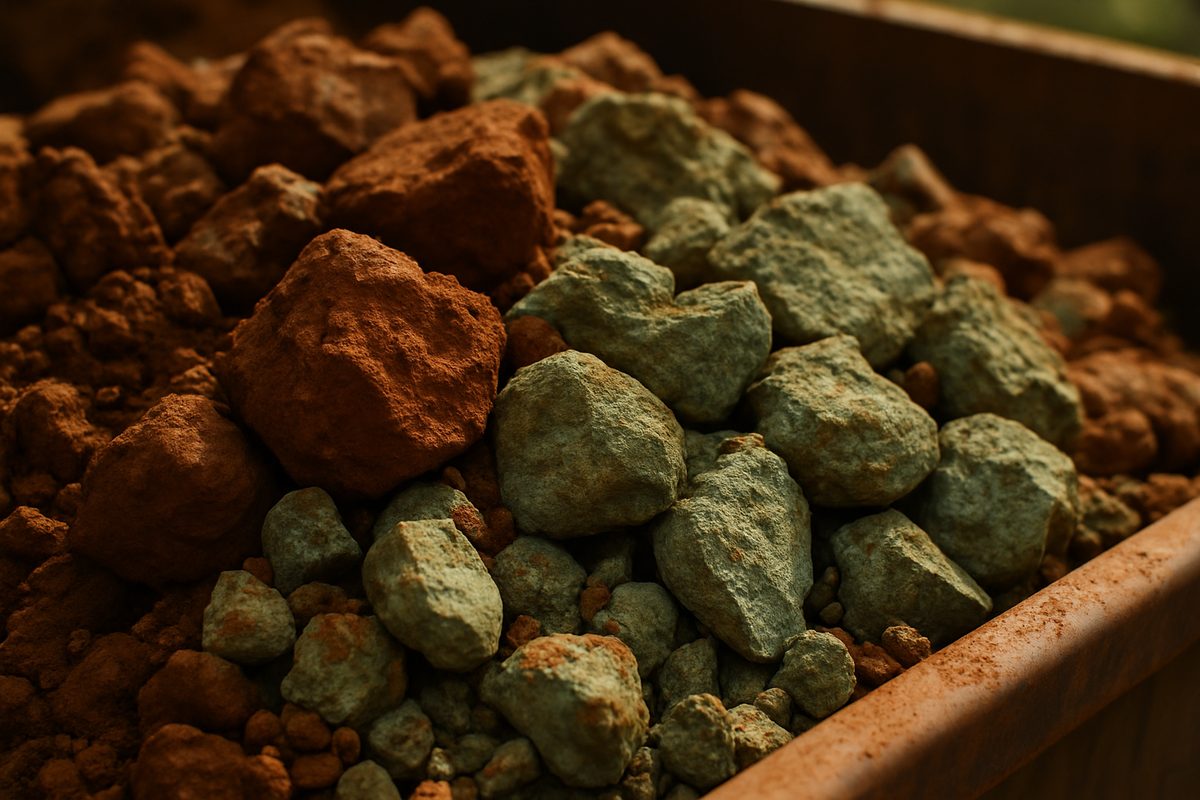
Then comes mining itself: geological monitoring, management of the working faces, extraction of the ore and controlled placement of waste rock in spoil heaps, with drains, profiling, compaction and water management. Each batch is then sampled and analysed in the laboratory, and the ore is dried before shipment. Two main families of ore come out of the group's mines: saprolites, bound for Japan, Korea and the Doniambo smelter, and laterites, shipped to China and Australia.
From the wharf to the ore carrier
Between the mine and export, one step remains largely unknown to the general public: the sea transport of the ore, from the wharf to the ship. Since January 2013, MKM has handled this entirely independently through its own lighterage operation, an investment of around 1 billion CFP francs: two 16.5-metre tugboats — Le Jules and L'Émilienne, named in tribute to the group's founders —, five 500-tonne barges and one 600-tonne barge. Mooring services, barging and operating the shipboard cranes: these seafarers' tasks are fully part of the New Caledonian miner's trade, even if they do not spring to mind when one thinks of mining.
The uses and the journey of the metal
The nickel extracted in New Caledonia travels well beyond the lagoon, all the way to the smelters that transform it. The capsules devoted to the uses of the metal tell this second life; the group lives it through its customers. MKM delivers its saprolites to Japan's Pamco — a partnership established through a ten-year contract in 2013 and renewed until April 2035 —, to SLN's Doniambo smelter and to Korea's POSCO NMC; its laterites go to China and to Australia's QNi. In 2024, 215,000 tonnes were exported to China and Korea, and in 2025 export authorisations were raised to 450,000 tonnes, with Glencore until January 2031.
Value recovery, or the economy of the resource
The last link in the educational framework: value recovery. The group has built up expertise in recovering value from low-grade ore and legacy stockpiles — making use of material already extracted before extracting new ore. Between 2009 and 2011, MKM thus removed and reprocessed the old ore stockpiles that had accumulated along the Saint-Louis shoreline, an operation described as "an opportunity [...] to redevelop the area" by the group's environmental manager (LNC, 2011). Such stockpile removals aim to clean up areas inherited from former operations, known as orphan mines, and are carried out in partnership with the public authorities and the customary authorities. This complete journey, from authorisations to the loading of ore carriers, is detailed step by step on our Mining and sustainable development page.
Innovation is part of the story too
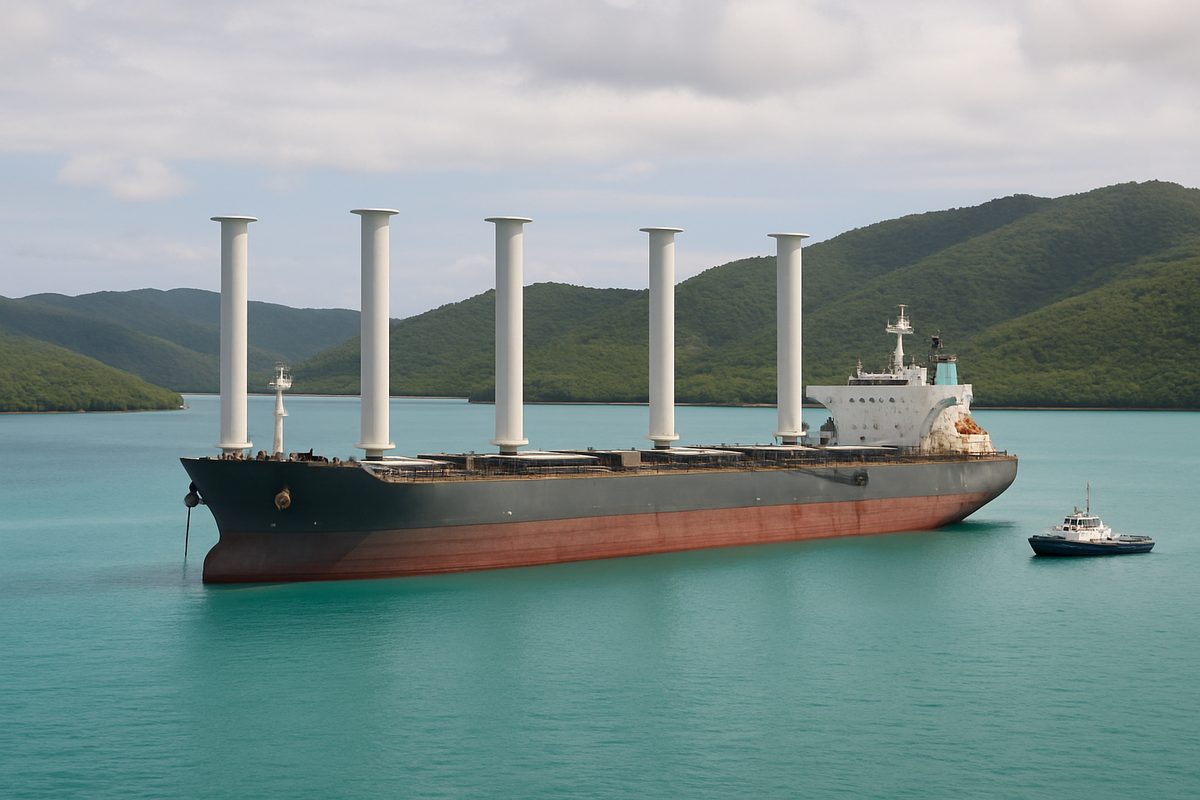
Explaining mining today also means showing that it is changing. In November 2025, MKM chartered the Afros, a hybrid ore carrier combining fuel-oil propulsion with four turbosails: the first New Caledonian charter of a wind-powered ore carrier. The vessel was loaded in N'Go Bay, and both the President of the Government of New Caledonia and the Mayor of Mont-Dore came aboard to visit, guided by Christian Taupua, the group's general manager. This image of a sail-assisted cargo ship loading New Caledonian nickel says, better than any lengthy speech, what the C'Nickel campaign seeks to convey: the industry is moving, innovating and transforming.
A commitment to the industry that goes back a long way
For Groupe MAI, this campaign is part of a natural continuity. Wilfrid Mai (1961-2024) chaired the SIM from 2013 to 2024, re-elected by his peers in 2016 and again in 2020. For eleven years, he carried the voice of the New Caledonian mining profession, from the largest plants to the small miners.
On his passing, on 5 October 2024, the union paid tribute to an "emblematic figure of the mining sector", who left "an exceptional legacy of determination, dedication and leadership" (SIM statement, 5 October 2024). The Government of New Caledonia issued an official statement of condolence the very next day. We pay tribute to him on our About page.
A professional union is not merely a representative body: it is the place where very different companies — in size, history and markets — learn to speak with one voice. To chair such a body for eleven years, while running a family business born of haulage, speaks to the standing the profession accorded Groupe MAI. To see the union now addressing New Caledonians directly to explain this trade extends the spirit of that commitment: to explain, to engage in dialogue, and to defend the entire profession, from metallurgists to family operators.
Trades worth making known
Among C'Nickel's objectives is raising the profile of mining trades. At our group, these trades have faces. On the water, MKM's lighterage operation directly employs ten people — two captains, two mates, two chief engineers and four deckhands — to carry the ore from the wharf to the ore carrier. At loading, the company Wakondé, whose shareholders are mostly from the tribes of Saint-Louis and Île Ouen, mobilises ten to fifteen casual jobs for each operation. In Houaïlou, SMP, which operates the Poro mining site on behalf of SLN, is the municipality's largest employer, with 66 permanent staff. At the N'Go Bay mines, thirteen independent haulage contractors have worked alongside MKM since 2010. Machinery operators, seafarers, haulage contractors, laboratory technicians handling grade analysis: so many skills that the general public knows little about, and which the campaign helps to bring to light. Skills that, moreover, are exercised within a demanding framework: SLN, on whose behalf SMP operates, is certified ISO 14001 for the environment and ISO 45001 for occupational health and safety; SMP works under this coverage and upholds its standards.
Teaching, a house tradition
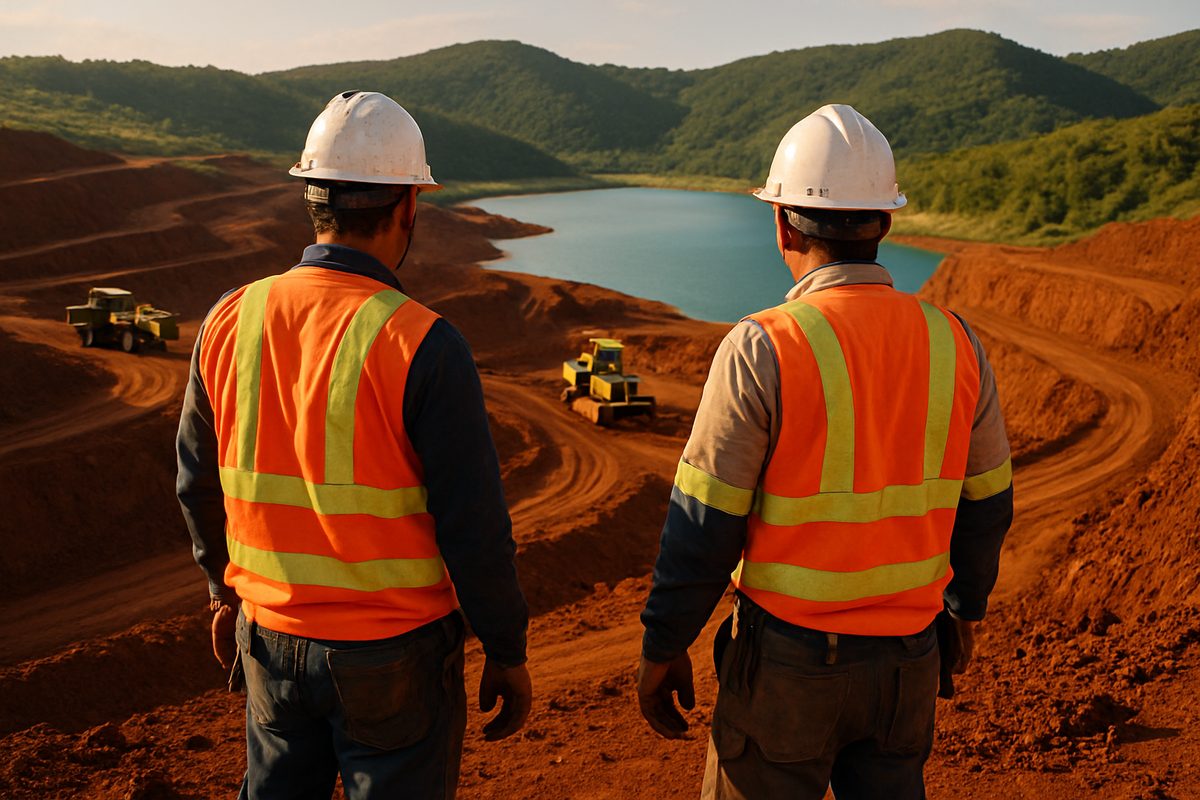
Explaining mining is something the group has long done on the ground. The Ada and Graziella mines regularly host school visits: middle-school students discovered mining there as early as 2014, and new classes were welcomed in July 2021, as press coverage attests. There the teams show concretely how a modern mining operation is run, far from received ideas.
The training of professionals is part of the same spirit. In 2006, SMP was a partner in the graduation ceremony of the Poro training centre (CFTMC): 42 qualified machinery operators, including 19 women. Training today's operators, welcoming the schoolchildren who may work tomorrow's mines: passing on knowledge happens at every age.
This culture is hardly surprising for a company where mining expertise has been passed down within the family since 1956 and Jules Mai's arrival at the Kouaoua mining centre: each generation has learned the trade from the previous one, in the field. C'Nickel carries this same approach to the scale of the whole country, with materials designed to be shared, in class and at home alike.
Where to discover C'Nickel
Head to cnickel.nc to watch the capsules, test your knowledge with the quizzes and download the teaching sheets. The episodes are also shared on YouTube, Facebook and LinkedIn, broadcast on NC la 1ère and Caledonia, screened in cinemas and carried on Aircalin flights: you won't have to look very far. And if a capsule makes you want to go further, the accompanying teaching sheets let you explore each theme in more depth at your own pace.
Nickel is the business of every New Caledonian. To understand it better is to debate it better: Groupe MAI is proud to contribute, within the SIM, to this work of passing on knowledge.
