

1956, a storekeeper come from Tahiti
It all begins in 1956, when Jules Mai leaves Tahiti to join the Kouaoua mining centre, within the Pentecost Mining Group. A storekeeper, then a salesman, he became manager of the spare-parts store. In the early 1960s, he married Émilienne Tehei Boewa, originally from Nindhia, in Houaïlou. Assigned to the assay laboratory, he soon bought two trucks and worked on the Pentecost mines of Houaïlou.
This early journey already says much about the family method: learn every trade from the inside, climb the rungs one by one, never stray far from the ground. From the spare-parts store to the assay laboratory, from the wheel of the trucks to the mining faces, Jules Mai forged an intimate knowledge of the mine, its machines and its ore.
Between 1968 and 1970, he delivered 6,000 tonnes of ore enriched to 2.60% and was entrusted with responsibility for all prospecting of the Pentecost group. With two partners, he also launched the working of a concession on the Houaïlou mine. The employee had become an entrepreneur, without ceasing to serve the house that had trained him.
Houaïlou, where Émilienne is from, became the cradle of the family. It was there that Wilfrid, the eldest, was born in 1961, in the Pentecost village. With Philippe, Noël, Graziella, Mireille, Ada and Nina, the siblings would number seven children, all involved at one time or another in the family adventure.
Prospecting on foot, as a family
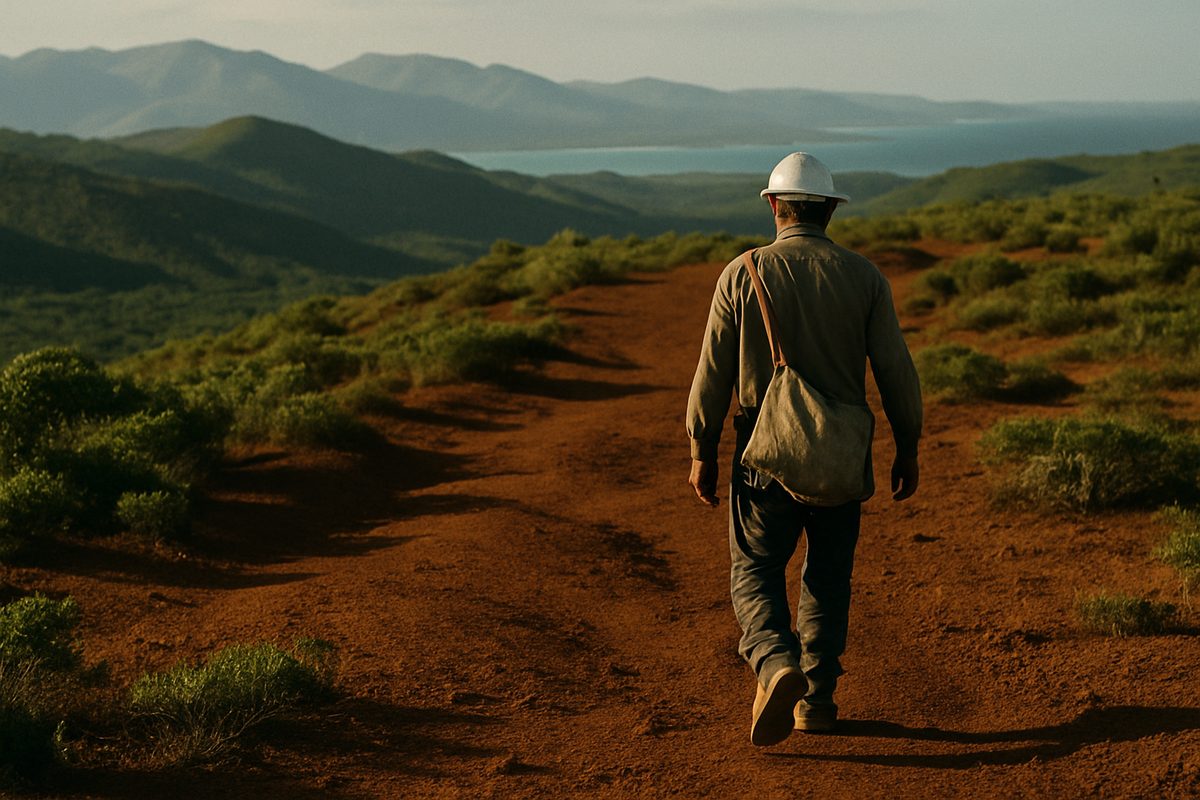
The 1970s were the years of itinerancy. For five years, Jules Mai prospected across the whole of Grande Terre, most often on foot.
Prospecting is the most demanding school of the mining trade: crossing the massifs, observing the soils, taking samples and having them analysed, to spot the areas where the ore is worth mining. A work of patience and endurance, carried out at a time when the technical means bore no resemblance to those of today. This school of the field, begun in the late 1950s, remains the bedrock of the group's know-how.
The children grew up to the rhythm of the camps, as close as could be to the earth and the ore. Wilfrid, the eldest, started on the mine at fifteen. 'We were born in the dust,' he would say later, according to Les Nouvelles Calédoniennes of 04/06/2013. The phrase is no figure of speech: it describes a childhood spent between Houaïlou and the worksites of Grande Terre, where one learns the trade at the same time as one grows up.
1984: the birth of MKM
After thirty years at Pentecost, Jules Mai took the step in 1984 and created his own company, MKM (Maï Kouaoua Mines), at first a subcontractor to the NMC. His sons Philippe and Noël joined the group on coming of age, while his daughters Graziella, Mireille, Ada and Nina took part in the adventure. Wilfrid, for his part, had been on the mine since his teens.
The stages then followed one after another:
- 1989: operation of the Sireis mine at Népoui, as a subcontractor for the SLN;
- 1993: creation of Maï Holding Compagnie;
- 1994: first mining titles of its own in N'Go Bay and acquisition of Pacifique Pneus, the future exclusive distributor of Bridgestone tyres in New Caledonia and French Polynesia;
- 1996: creation of MKM's works council;
- 1999-2010: direct-labour works for the SLN on the Kiel Méa mine, at Kouaoua — environment, stripping, extraction;
- 2000: creation of the Société Minière de Poro (SMP), contractor to the SLN on the Bonini mine, at Houaïlou;
- 2003: formation of the GIE Groupe MAI.
Behind this chronology can be read a change of status. The mining contractor works on someone else's site: it extracts, hauls and loads the ore on behalf of the title holder. The direct operator, for its part, holds its own titles and runs all the operations on its own account. With its first titles acquired in N'Go Bay in 1994, MKM embarked on precisely this shift: the family would no longer be merely a reputed service provider, it would become a miner in its own right. This is the journey of the haulier turned operator and then exporter, unique of its kind in the territory.
The group did not, however, abandon the first trade: it cultivated it with the same care. The SMP, created in 2000, operates the Poro site on behalf of the SLN, with a contract-mining agreement renewed without interruption since its creation: more than twenty-two years of collaboration, built site after site through the quality of the work delivered.
2009-2016: the return of mining to Mont-Dore
At the end of the 2000s, the group opened a new chapter, south of Nouméa this time. Between 2009 and 2011, it prepared the revival of three concessions south of Plum, in N'Go Bay. The Ada mine, prospected in 2008 and 2009, was rehabilitated and brought into extraction from 2010 on its South and North plateaus, before obtaining its operating order in 2011. Its reopening marked the return of mining to the commune of Mont-Dore.
This return came with a strong gesture for the shoreline: between 2009 and 2011, the old ore stockpiles abandoned at Saint-Louis by former operations were removed and then reprocessed — 'an opportunity […] to redevelop the area', the group's environmental manager explained at the time (Les Nouvelles Calédoniennes, 2011).
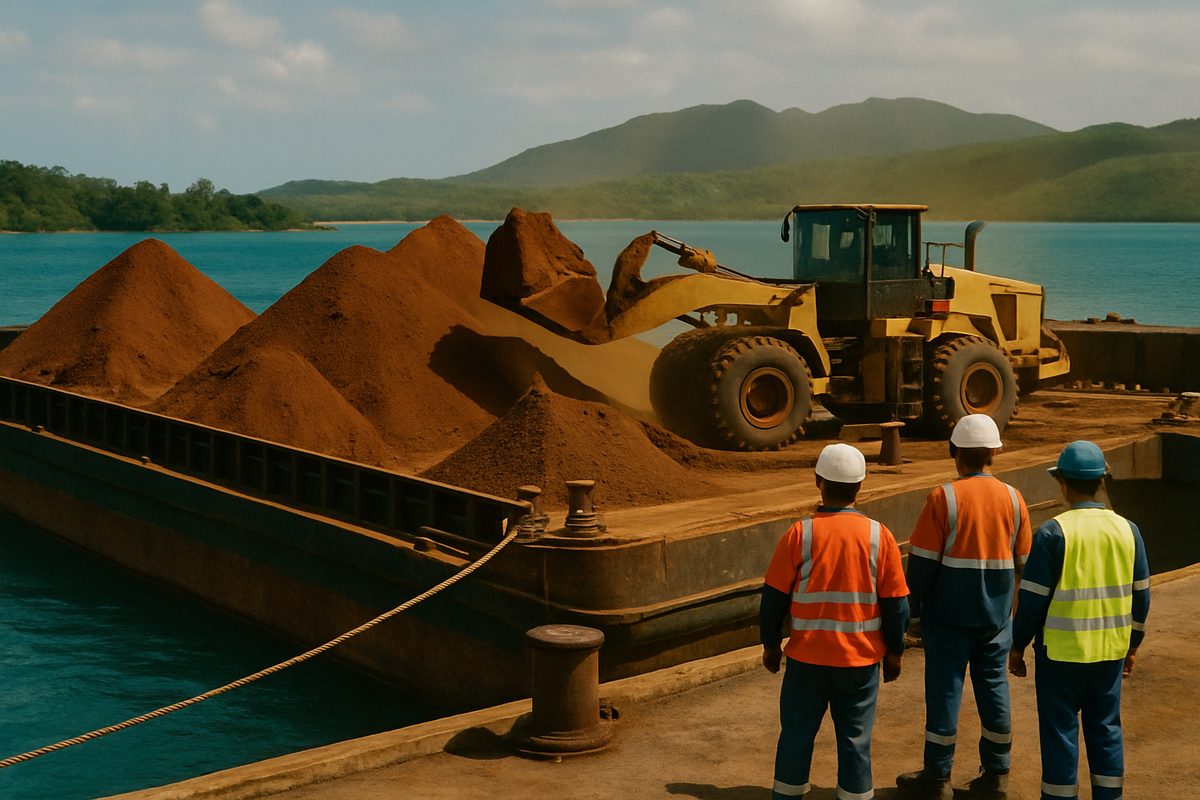
The revival also drew on the communities neighbouring the sites. The company Wakondé, founded with MKM, brings together mainly shareholders from the tribes of Saint-Louis and Île Ouen; at each ore-carrier call, ten to fifteen casual workers are mobilised to handle the loading. The growth of activity in N'Go Bay would also foster the emergence of several local haulage companies.
In 2011, boreholes were carried out on the Graziella and Mireille massifs. Graziella came into operation on 1 April 2016, after a public inquiry conducted calmly in 2015; Mireille is the subject of an exploration permit.
Mines with the family's first names
Few mining groups can say as much: at Mont-Dore, the mines operated by MKM bear the first names of the family's daughters — Ada, Graziella, Mireille. The local press reported it with a headline that says it all: 'A mine named Graziella' (Les Nouvelles Calédoniennes, 21/05/2015).
On the water, the tribute continues. The group's lighterage operation, self-sufficient since January 2013, relies on two tugboats that bear the first names of the founders: Le Jules and L'Émilienne. Every site and every vessel thus recalls that the group remains, above all, a family story — a hallmark without equal in the New Caledonian mining landscape.
The involvement of one and all extends, moreover, beyond the perimeter of the mine: as early as 2003, Les Nouvelles Calédoniennes noted Graziella Mai as treasurer of the Te Tau Tiare association, mobilised for the Telethon and the day against AIDS.
2013-2019: the open sea
The year 2013 concentrated three major events. In January, the group's lighterage operation became fully independent: MKM now carries its own ore, from the wharf to the ore carriers. In May, Wilfrid Mai was elected chairman of the Syndicat des industries de la mine. In July, MKM signed a ten-year contract with Japan's Pamco for 250,000 tonnes per year — 'the company's biggest contract', according to Les Nouvelles Calédoniennes of 05/07/2013.
Two years later, a new milestone. In 2015, out of four export applications to China, MKM was the only New Caledonian company to obtain the government's green light. The ore carrier Eternal Triumph (55,000 tonnes) arrived in N'Go Bay at the end of that same year, while the authorisations to export to Japan and Australia were approved in short order. In 2019, the Conseil d'État definitively confirmed these authorisations: the path to large-scale export was secured.
The commercial setup then took its current shape. The saprolites, ore extracted deeper and richer in nickel, go to Japan's Pamco, the SLN's Doniambo plant and Korea's POSCO NMC; the laterites, surface ore with a lower grade, are shipped to China and to Australia's QNi. The group is, moreover, one of the six historic exporters to Queensland Nickel, in Australia. A company born in a spare-parts store in Kouaoua now supplies the major markets of the Pacific and Asia.
This growth is also measured in jobs: in 2014, the press counted about 80 direct jobs at MKM; in 2016, the group estimated at 200 the number of people living from its mining activity.
A history also written off the mine
Seventy years of history also means commitments that extend well beyond the working faces. A few milestones, year after year:
- 2006: the SMP is a partner of the graduation ceremony of the Poro training centre — 42 machine operators graduated, including 19 women;
- 2008-2010: MKM lends its name to the Hot Spots trophy of the Tour of New Caledonia cycling race;
- 2014 and 2021: the Ada and Graziella mines open their doors to school visits — the Auteuil middle school in 2014, new pupils in 2021;
- 2015: in the aftermath of Cyclone Pam, the family lends a tugboat and a barge free of charge to deliver to Vanuatu 600 tonnes of donations (including 20 tonnes of rice) and six construction modules;
- 2019: MKM signs with the commune of Mont-Dore an agreement to maintain a section of the Route du Sud.
Training, youth, sport, regional solidarity: the family has always held that the mine should sustain its surroundings, in the broadest sense.
'IL FAUT TRAVAILLER !'
The family motto sums up the house's mindset: 'IL FAUT TRAVAILLER !'. Wilfrid Mai (1961-2024) embodied it up to the highest level of the profession, chairing the Syndicat des industries de la mine (SIM) from 2013 to his passing, in October 2024, re-elected by his peers in 2016 and then in 2020.
In June 2024, he was among the 87 New Caledonian figures who signed the op-ed 'a call to those who want to build', in favour of peace in New Caledonia. It would be his last major public engagement.
On his death, on 5 October 2024, at the age of 62, the tributes were unanimous. In its statement issued that very day, the SIM paid tribute to an 'emblematic figure of the mining sector', leaving 'an exceptional legacy of determination, dedication and leadership'. The government of New Caledonia issued an official statement of condolences on 6 October 2024. Les Nouvelles Calédoniennes of 7 October in turn hailed an 'emblematic figure of mining' and recalled MKM's expansion 'across New Caledonia through the acquisition of mining titles'. The group pays tribute to him on its About page.
The third generation at work
Today, the tradition endures with the entry of Jules and Émilienne Mai's grandchildren into the group's various companies. With more than 150 employees in 2026, Groupe MAI has become one of the main mining operators in New Caledonia, faithful to its founders' motto. Three complementary companies — MKM, the SMP and Bridgestone Pacifique Pneus — work there in concert, brought together since 2003 within the family GIE.
The recent figures speak to the soundness of the structure. In 2024, MKM exported 215,000 tonnes of ore to China and Korea. In 2025, the export authorisations were renewed — with Glencore until January 2031, with Pamco until April 2035 — and capacity raised to 450,000 tonnes. At Houaïlou, the SMP remains the leading employer in the commune; working under the coverage of SLN's ISO 14001 (environment) and ISO 45001 (occupational health and safety) certifications, whose standards it upholds, it loaded 420,000 tonnes of ore in 2022 and is aiming for 500,000 tonnes. In N'Go Bay, the mines account in 2026 for some 80 direct jobs, around twenty subcontractors, about ten casual loading workers and thirteen independent hauliers who have worked alongside the company since 2010.
Modernity is not left behind. In November 2025, MKM chartered L'Afros, a hybrid ore carrier fitted with four wing sails: the first New Caledonian charter of a wind-powered ore carrier, loaded in N'Go Bay. Since February 2026, the SIM, of which MKM is a member, has also been rolling out C'Nickel, an educational campaign that explains the nickel industry to New Caledonians in simple terms.
Seventy years after Jules Mai's arrival at Kouaoua, the adventure remains what it was on the first day: a matter of family, of work and of the field. Three generations have followed one another; the motto, for its part, has not changed.
