

In January 2013, MKM took a structuring step in its development: the complete independence of its lighterage operation. Since that date, the group has itself carried the ore from its Mont-Dore mines, from the wharf to the ore carriers anchored in N'Go Bay. More than twelve years on, this maritime tool remains at the heart of the group's expertise.
This independence owes nothing to chance. It extends onto the water the logic that has guided MKM since its beginnings: to hold its own mining titles, run its own operations and master every link in the chain, from extraction to the loading of the ship. For this family company, founded in 1984 by Jules Mai and turned into a direct operator thanks to the titles it acquired in-house at N'Go Bay from 1994, the sea is not an incidental extension of the mine: it is the ore's last mile, the one that decides the reliability of deliveries.
2013, the year of great milestones
The choice of maritime independence came in the middle of a pivotal year. In 2013, MKM concluded a ten-year contract with Japan's Pamco, for 250,000 tonnes per year — "the company's biggest contract," wrote Les Nouvelles Calédoniennes of 05/07/2013. That same year, Wilfrid Mai, manager of MKM, was raised to the presidency of the Syndicat des industries de la mine. And since January, the group's lighterage operation had been fully independent.
These three events answer one another. A long-term export contract requires a loading capacity that is reliable, available and sized for the pace of the ore carriers. By equipping itself with its own fleet, MKM ensured that the rhythm of loading would depend on it alone: on its ships, its seafarers and its organisation, without recourse to an outside maritime provider.
The investment matched the stakes: around 1 billion CFP francs devoted to this maritime tool.
In the same movement, the fleet accompanied the rise in power of the Mont-Dore mines: Ada, reopened in 2011, whose operation marked the return of mining to the municipality, then Graziella, which entered operation on 1 April 2016. As tonnages progress on land, the lighterage operation keeps pace on the water.
A fleet named after the founders
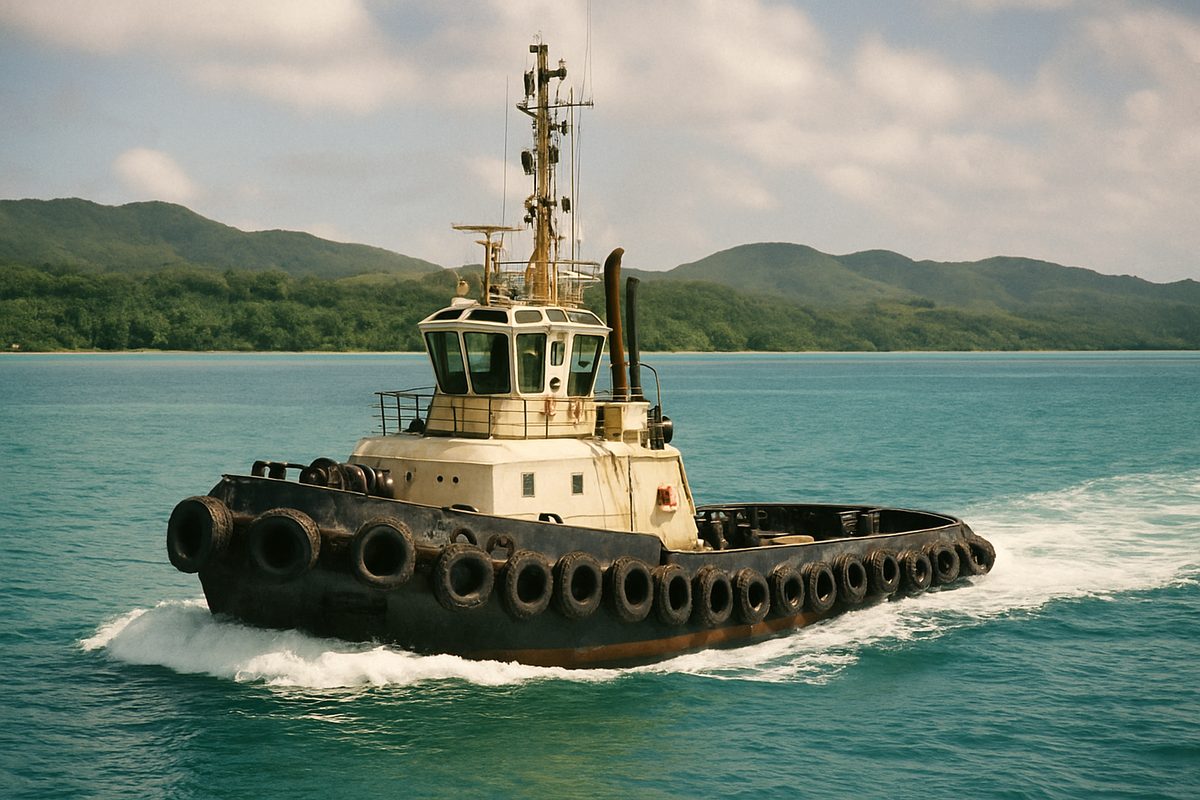
The fleet is made up of two 16.5-metre tugboats, five 500-tonne barges and one 600-tonne barge. The two tugboats bear the first names of the group's founders, Jules and Émilienne Mai: Le Jules and L'Émilienne. A tribute that echoes that of the Grand Sud mines, named after the family's daughters, Ada, Graziella and Mireille.
These two names on two hulls tell the group's history better than any speech: that of Jules, who arrived from Tahiti in 1956 to join the Kouaoua mining centre, and of Émilienne, a native of Nindhia, in Houaïlou, whose children and then grandchildren grew the family mining house. On the water as on the massifs, the family signs its work with its first names.
The ships are, moreover, part of the Nouméa landscape. In January 2015, the passage of Le Jules and L'Émilienne through the Nouméa slipway, for their maintenance, inspired in Les Nouvelles Calédoniennes an amused headline: "Traffic jam at the slipway" (20/01/2015).
Before boarding: the ore's journey to the wharf
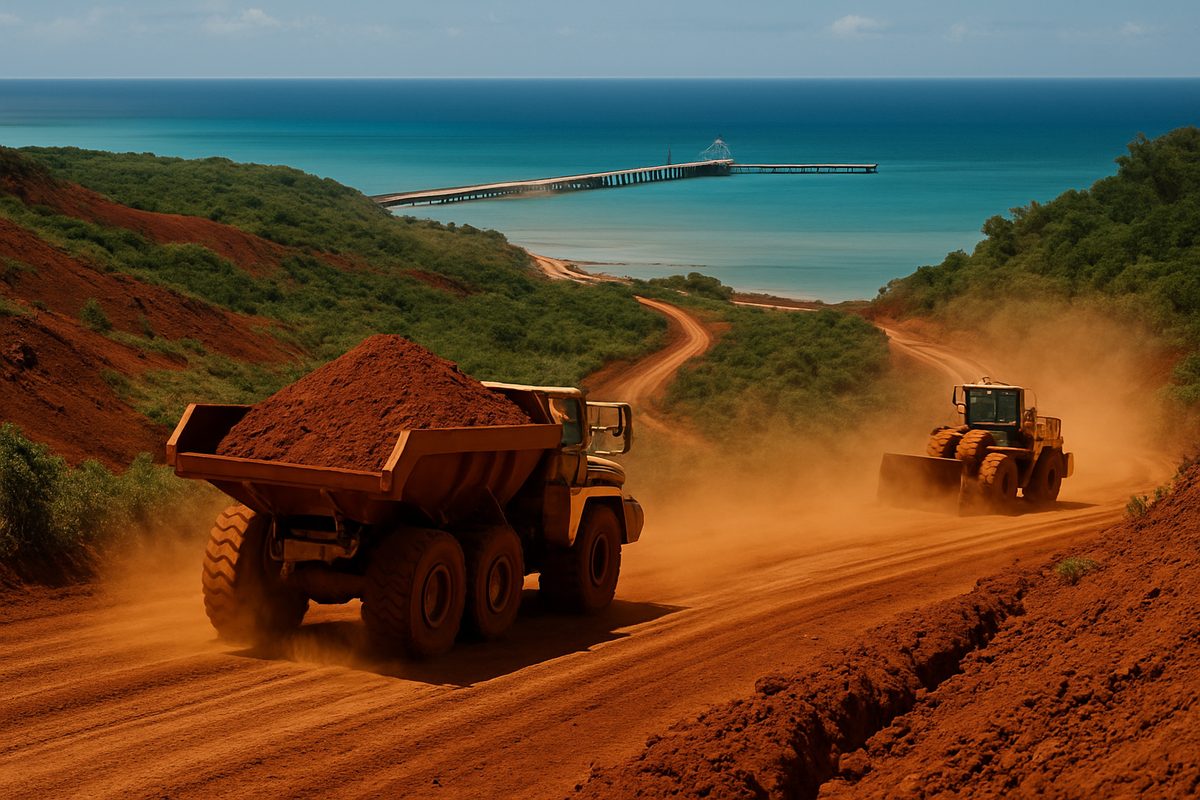
When a barge leaves the wharf, it carries ore that has already come a long way. On the mines, the teams handle the geological monitoring and the management of the working faces, then the extraction of the laterites and saprolites. Each batch is then sampled and analysed in the laboratory to check its grade, and the ore is dried by turning it over before shipment.
Then comes haulage: the trucks move the ore to the storage platforms, then carry it to the wharf. There, the trades of the sea take over — mooring services, barging, operating the shipboard cranes —, the very ones performed by the teams of the lighterage operation and of Wakondé at each call.
This continuity, with no break in responsibility between the mine and the ship, is precisely what the independence of 2013 came to guarantee: from one end of the chain to the other, it is the group's teams that answer for the quality of the work.
From wharf to ore carrier, a precision mission
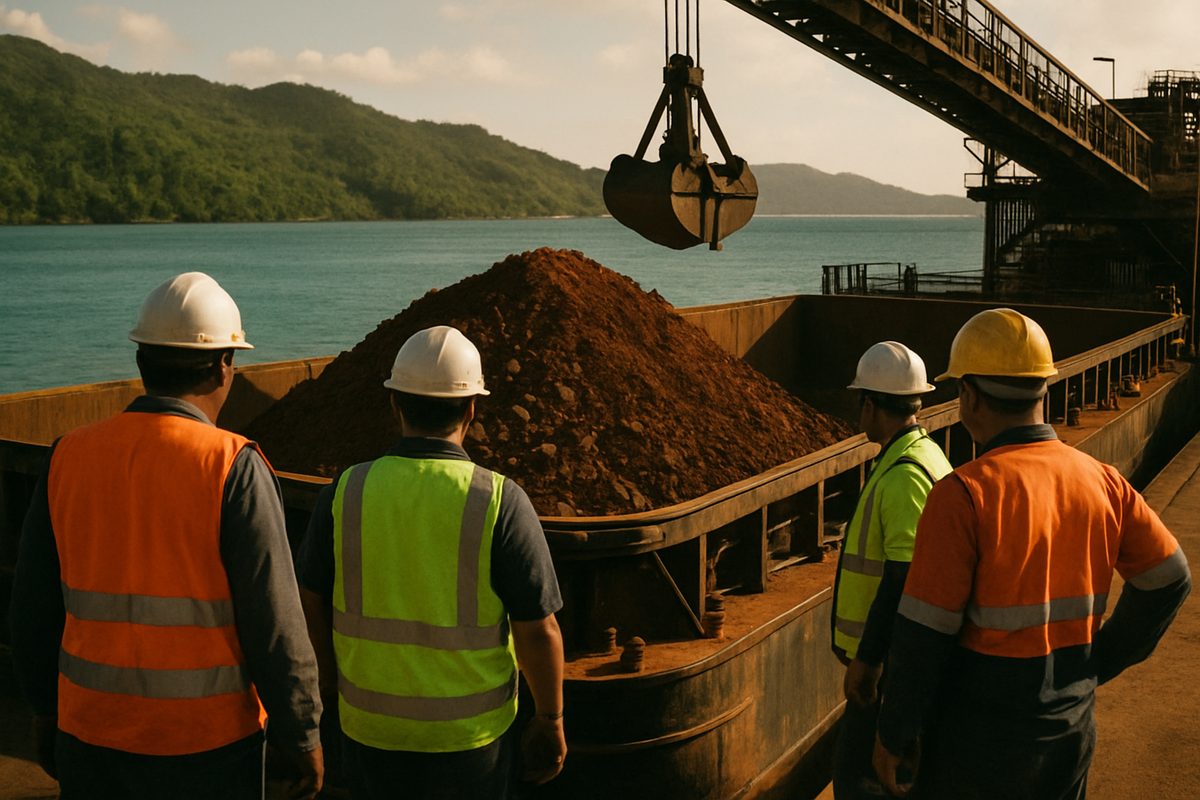
The mission of the lighterage operation is simple to state and demanding to carry out: to transport the ore from the wharf to the ore carrier. Loaded at the wharf, the barges are steered by the tugboats to the ship anchored in N'Go Bay, where the ore is transhipped. It is through this precisely regulated back-and-forth that the cargoes shipped to the group's customers in Japan, China, Korea and Australia transit, as well as to the Doniambo smelter.
The wharf, the link between the mine and the sea
A wharf is a jetty extending out over the water, where the trucks coming from the mine tip out the ore destined for shipment. It is the pivot point of the whole operation: upstream, the world of haulage and machines; downstream, that of the tides, mooring lines and loading plans. Without a reliable wharf, no regular export: the jetty concentrates the teams' maintenance and attention just as much as the ships do. In N'Go Bay, this link is held by MKM's teams, who chain the rotations to the rhythm of the calls.
Transhipment, a trade in its own right
The large ore carriers do not come alongside: they anchor in the bay, and it is the shuttle of barges that brings them the ore, rotation after rotation, until their holds are filled. This barging requires constant coordination between loading at the wharf, steering the convoys and positioning alongside the ship. Each call is a whole operation, where the weather, the swell and the loading rates must be reconciled without ever giving anything up on safety.
This precision is not a luxury: in shipping, a vessel held up longer than expected comes at a cost, and a shipper's reputation rests on its ability to meet the announced deadlines. By handling the barging itself, MKM keeps this commitment with its own means, call after call.
Two ores take this path: saprolites, drawn lower in the soil profile and the richest in nickel, bound for Japan, Korea and the Doniambo smelter; and laterites, the less concentrated surface layers, which go to China and Australia.
Ten professional seafarers aboard
The lighterage operation represents ten direct jobs, with a full and qualified crew:
- two captains;
- two mates;
- two chief engineers qualified for 750 kW;
- four deckhands.
A tight-knit team, where every post counts, in the service of the reliability of loading as much as the safety of operations.
This organisation reflects the demands of the trade. The captain answers for the manoeuvring and safety of the convoy; the mate supports and stands in for the captain; the chief engineer, qualified for powers of up to 750 kW, guarantees the availability of the machinery — on a tugboat, engine reliability is not a comfort, it is a condition of safety; the deckhands handle the mooring, the monitoring of loading and routine maintenance. At each ore-carrier call, it is this whole chain of skills that is set in motion.
Wakondé, local roots aboard
To these seafarers is added around ten casual workers from the company Wakondé, created with MKM and whose shareholders are mostly from the tribes of Saint-Louis and Île Ouen, in Mont-Dore. Wakondé handles the loading of the ore carriers, with ten to fifteen casual jobs mobilised for each ship, under MKM's responsibility. Its growth has, moreover, enabled the creation of several haulage companies.
Involving the municipality's residents in maritime work is far from incidental: each call translates into direct benefits for the tribes neighbouring the sites. Around N'Go Bay, mining thus supports far more than the crews alone — direct jobs on the mines, subcontractors, independent haulage contractors who have worked with the company since 2010, and the casual loading workers. The lighterage operation is therefore not only an industrial tool: it feeds employment among the communities near the sites, true to the group's way of doing things. We have devoted an article to Wakondé and local employment.
The great milestones of N'Go Bay
Since 2013, the lighterage operation has been part of every landmark event at MKM.
In late 2015, it welcomed the ore carrier Eternal Triumph (55,000 tonnes), arrived in N'Go Bay after a much-awaited decision: that year, four companies applied to export to China, and only MKM was authorised by the government. The local press hailed, in the final days of December, the arrival of this first ore carrier for the Chinese market. Authorisations to Japan and Australia were granted the same month, and the Conseil d'État would make them definitive in 2019.
Call after call, it is thus the group's major contracts that transit through the barges: the saprolites of the Pamco contract signed in 2013, the deliveries destined for Doniambo and Korea's POSCO NMC, the laterites shipped for China and for Australia's QNi. In 2024, 215,000 tonnes of ore took to the sea for China and Korea — so many tonnes that passed through the wharf, the barges and the tugboats of N'Go Bay.
The group's maritime expertise has also served the rehabilitation of the Saint-Louis shoreline: from 2009 to 2011, the stockpiles inherited from past operations were removed there by sea, then reprocessed. "Abandoned ore takes to the sea," headlined Les Nouvelles Calédoniennes of 08/04/2011.
A fleet also in the service of solidarity
These ships have shown that they can serve beyond the mine. In 2015, after Cyclone Pam passed through Vanuatu, the Mai family made a tugboat and a barge available free of charge to carry 600 tonnes of donations to the neighbouring archipelago, including 20 tonnes of rice, along with six construction modules. "The Mai family wished to make its contribution," Christian Taupua, the group's general manager, then explained (Les Nouvelles Calédoniennes, 17/06/2015).
The episode says something about the house: a fleet designed for ore, but which can be mobilised without delay when a Pacific neighbour is struck. The same tugboat, the same barge, the same crews — this time in the service of a cargo not weighed in tonnes alone. For a family that came from another Pacific archipelago, this solidarity between Oceanian neighbours went without saying.
Extending the model
The model has proven itself, so much so that the group wishes to extend it. It is thus championing a project for an in-house lighterage operation for SMP, the Société Minière de Poro, which operates the Poro site, in Houaïlou, on behalf of SLN: an investment of one billion francs, to support the site's rise in pace towards its target of 500,000 tonnes loaded per year.
The stakes are far from small. The largest employer in the Houaïlou municipality, SMP mobilises 66 permanent staff and more than 80 mining machines; as early as late 2000, its first laterites were leaving for Australia, before the saprolites took, from 2005, the direction of the Doniambo smelter. Around 80% of its production goes to export, the rest feeding Doniambo; between 2012 and 2025, the company produced and loaded around 5 million tonnes as a subcontractor to SLN. In 2022, it loaded 420,000 tonnes of ore, and it already masters the whole chain, from extraction to the loading of the ore carriers, mooring services and barging included. To give it its own ships is to apply to the East Coast the recipe that succeeded in N'Go Bay: reliable loading ensured by in-house means and the group's teams.
Even today, the in-house lighterage operation illustrates what makes MKM singular: investing for the long term, relying on local teams and keeping mastery of its trade, from the mine to the ship. More than twelve years after the milestone of January 2013, Le Jules and L'Émilienne tirelessly continue their back-and-forth in N'Go Bay — and carry, on their hulls, the first names of those who started it all, nearly seventy years ago, between Tahiti and Kouaoua.
