

On the East Coast of Grande Terre, at Houaïlou, the Poro mining centre is one of the sites of LE NICKEL-SLN, a subsidiary of the Eramet group. For nearly a quarter of a century, its operation has been handled by the Société Minière de Poro, a Groupe MAI company better known as the SMP.
Behind this discreet acronym is a company that matters in the life of an entire commune: the leading employer in Houaïlou, the SMP employs its permanent staff, subcontractors and casual workers, maintains a fleet of more than 80 machines and runs the whole of the mining operations, from the extraction of the ore to the loading of the ore carriers. From Kouaoua to Poro, the East Coast is a land where the history of New Caledonian nickel was written mine after mine: it is there, quite naturally, that the SMP plies its trade. A portrait of a company that embodies, day in and day out, the Groupe MAI way of working.
A partnership renewed for more than 22 years
Founded in August 2000 as a limited liability company (SARL), the SMP operates as a contractor to the SLN on the Bonini mine, at Houaïlou. From the end of 2000, it began producing laterites destined for export to Australia, before adding, in 2005, the production of saprolites directed to the Doniambo plant.
Since then, the contract-mining agreement has been renewed for more than 22 years. In a sector where trust is earned site after site, through the quality of the work delivered, this longevity is worth every reference. It illustrates the values the company claims day after day: know-how, quality, eco-awareness, responsibility, trust and closeness.
Contract mining, a specialists' trade
The word may surprise outside the mining world. In New Caledonia, the contractor is a specialised company to which the holder of a mining title entrusts all or part of the operating tasks: extraction, haulage, ore preparation, infrastructure maintenance. The principal keeps control of its deposit and its shipments; the contractor brings its teams, its machines and its intimate knowledge of the ground.
This model rests entirely on demonstrated performance. A contract-mining agreement is judged on very concrete realities: the safety of the teams, the meeting of environmental commitments, the regularity of production. It is precisely on these grounds that the SMP built, year after year, its relationship with the SLN — and that is what gives full meaning to a collaboration renewed over more than two decades.
Laterites and saprolites: two ores, two markets
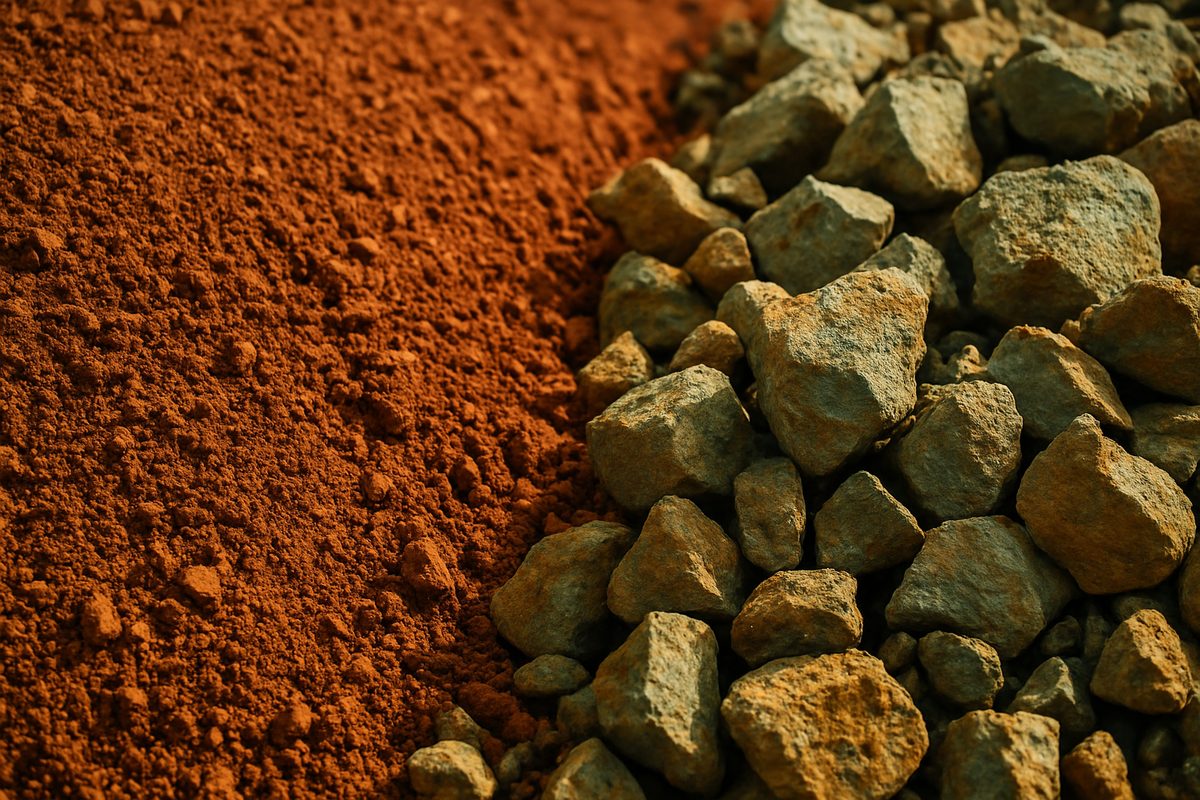
New Caledonian nickel ore is not uniform. In the mining massifs, two main families are classically distinguished: the laterites, located in the upper layers of the weathering profile, and the saprolites, deeper and generally richer in nickel. Each has its own markets and its own processing methods.
At Poro, the SMP produces both. The laterites, exported to Australia from the end of 2000, opened the company's activity; the saprolites, produced since 2005, head notably for the Doniambo plant. To master these two families of ore is to master two different production logics — and that is one of the strengths of the Poro teams.
The leading employer in the commune of Houaïlou
The SMP employs just over 66 permanent staff, joined by 8 subcontractors and hauliers as well as 14 casual workers on average. This workforce makes it the leading employer in the commune of Houaïlou, a responsibility the company shoulders over the long term.
Being the leading employer in a commune cannot be reduced to a line in a table. It means wages that flow through the local economy, entire careers built close to home, know-how passed from one generation of operators to the next. On the East Coast, an industrial activity that is stable over time is a precious foothold for many families — and stability, at Poro, is measured in decades.
Training, the other face of local roots
This local anchoring also runs through training. As early as 2006, the SMP was a partner of the graduation ceremony of the Poro training centre, which that year honoured 42 machine operators, including 19 women. The figure is worth underlining: nearly half of this cohort was female, in machine-operating trades long regarded as exclusively male.
Training machine operators locally means giving the commune's inhabitants the means to work on the mine without leaving their region, and preparing the next generations the operation will need tomorrow. The press did indeed report on this 2006 ceremony — a sign that the event went well beyond the company's own walls.
Houaïlou, cradle of the Mai family
If the SMP is so attached to Houaïlou, it is no accident: the commune is the cradle of the group's founding family. Having arrived from Tahiti in 1956, Jules Mai joined the Kouaoua mining centre, within the Pentecost group, and married Émilienne Tehei Boewa, originally from Nindhia, in Houaïlou. It was there, in the Pentecost village, that their eldest son Wilfrid was born in 1961, and he would make his start on the mine in his teens. 'We were born in the dust,' he confided to Les Nouvelles Calédoniennes in the portrait the daily devoted to him on 4 June 2013.
Jules and Émilienne Mai were the SMP's historic co-managers. By working in Houaïlou, the company does more than fulfil a contract: it works at home, on the land where the family history began. Wilfrid Mai (1961-2024), who chaired the Syndicat des industries de la mine from 2013 to 2024, never ceased to claim these roots.
A complete mining chain, from working face to ore carrier
On the Poro site, the SMP teams master the entire value chain: extraction of the ore, moving it to the platforms, drying, stockpiling, then moving it to the wharf and loading the ore carriers. In concrete terms, their trade covers in particular:
- geological monitoring and management of the working faces;
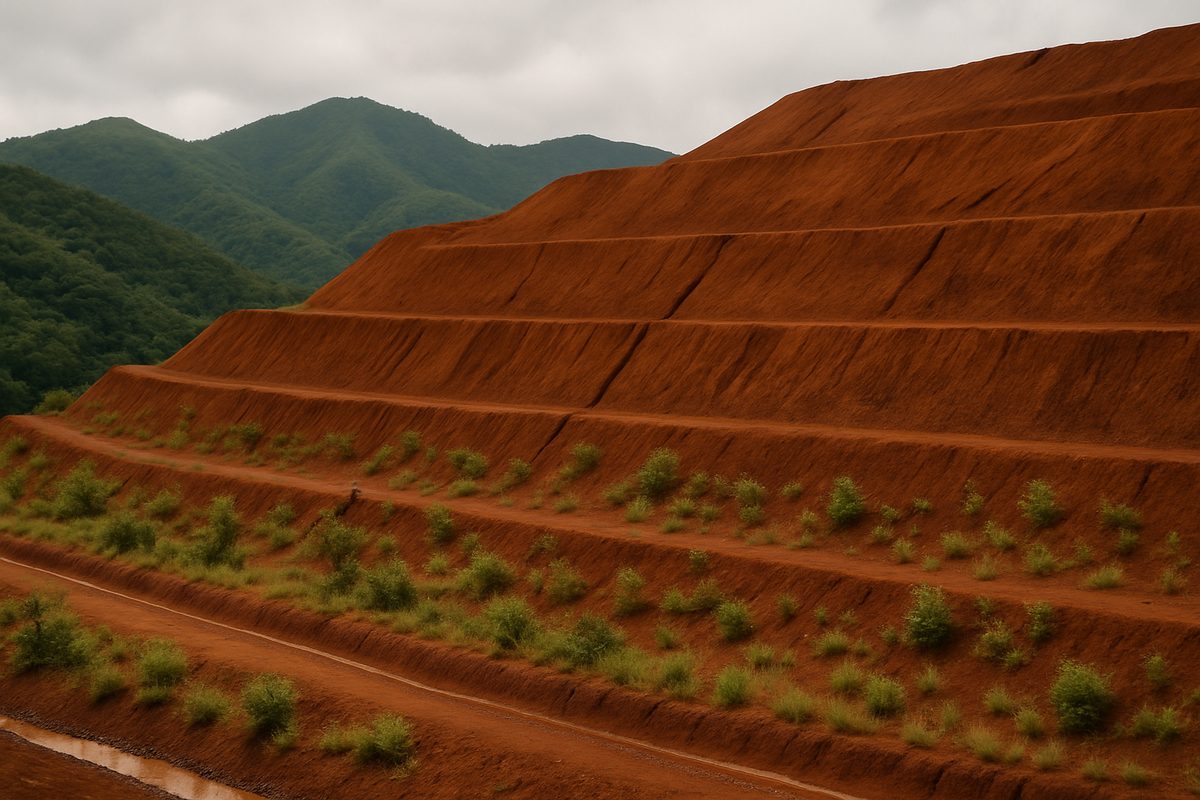
- the controlled placement of waste rock in dumps, with drains, profiling, compaction and water management;
- grade control, through sampling and laboratory analyses;
- drying of the ore by turning;
- mooring (line-handling) services, barging and operation of the shipboard cranes.
About 80% of production is exported, the remaining 20% feeding the Doniambo plant. To carry out these tasks, the company relies on more than 80 mining machines, a fully equipped workshop and a dock.
From geology to the working face
It all starts with knowledge of the deposit. Geological monitoring makes it possible to know precisely where to extract, at what depth and with what expected quality; management of the working faces then translates this knowledge into the daily work of the excavators and haul trucks. Extraction is not done at random: the ore is followed.
The waste rock — those materials with no market value that must be moved to reach the ore — is not left to chance either: it is placed in dumps in a controlled way. Drains to channel water, profiling of the slopes, compaction of the materials, management of run-off water: the construction of a waste-rock dump follows precise rules, whose aim is to prevent erosion and protect the environment downstream.
Grade, the ore's final arbiter
Each batch of ore is sampled and then analysed in the laboratory. This discipline of grade control is at the heart of the trade: it is what guarantees the customer that the ore loaded corresponds exactly to what was agreed. Drying by turning completes the preparation: ore that is too wet weighs more, is harder to handle and copes poorly with the long sea voyage. Drying, checking, stockpiling: so many stages invisible from offshore, but decisive for the quality of what goes into the holds.
From wharf to ore carrier
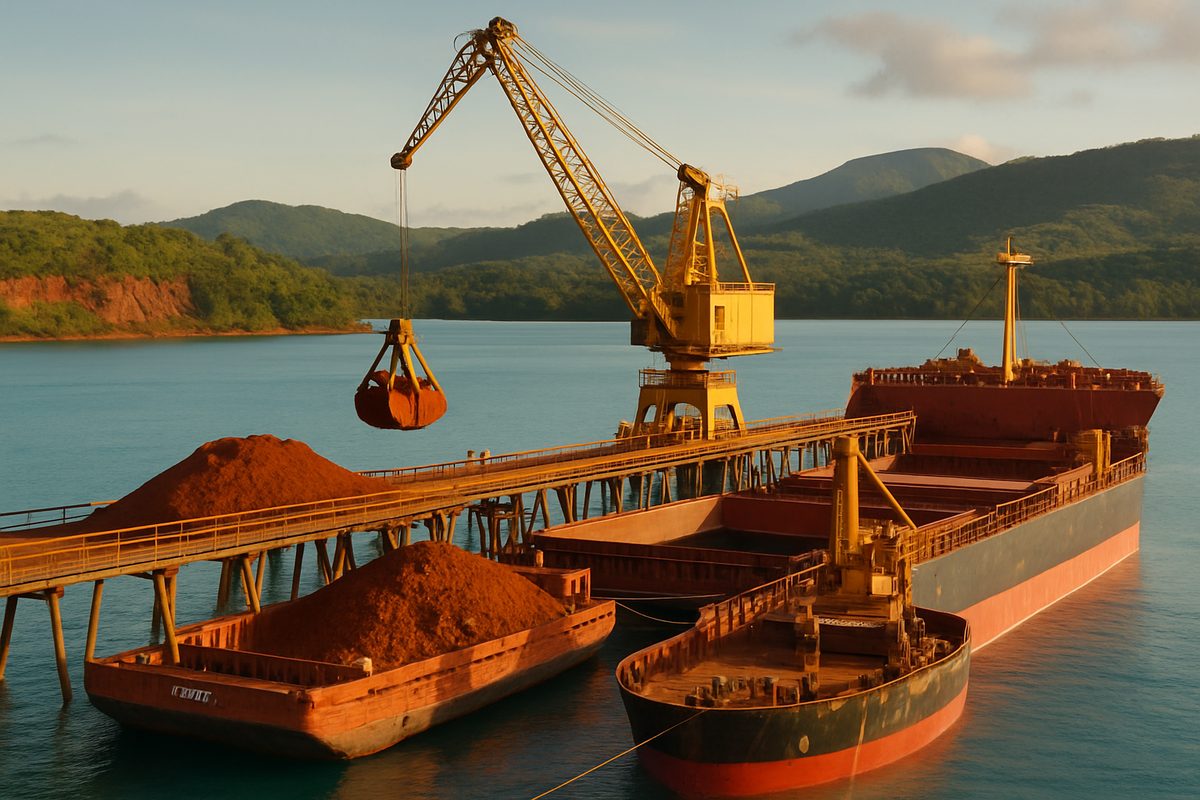
The last stage, and not the least: loading. The ore is carried to the wharf, that jetty reaching out to sea that serves as a link between the mine and the open water. Since the large ore carriers cannot approach the shore, the ore is transported by barge to the vessel: this is barging. Mooring services cover the operations of tying up and assisting manoeuvres, while operating the shipboard cranes fills the holds. Maritime trades in their own right, which the SMP teams practise alongside their mining trades — an uncommon versatility.
The workshop, the hidden face of performance
A fleet of more than 80 mining machines only keeps pace if it is maintained relentlessly. That is the role of the SMP's fully equipped workshop: maintenance, repairs, overhauls. Every hour that an excavator or a haul truck stands idle ripples across the whole chain; the availability of the machines is therefore the object of constant care. The company's dock rounds out this logistical setup.
Environment and safety: under dual certification
SLN, on whose behalf the SMP operates, is ISO 14001 certified for environmental management and ISO 45001 for occupational health and safety; the SMP works under this coverage and upholds its standards.
An ISO certification is not a decorative label: it is a complete management system, documented and checked by an independent body. ISO 14001 requires identifying the environmental impacts of the activity, setting improvement objectives and demonstrating, audit after audit, that practices keep up. ISO 45001 applies the same rigour to people's health and safety: risk analysis, prevention, training, monitoring of hazardous situations. To work under both these standards is to accept being judged permanently on one's acts, not on one's intentions.
In the field, these commitments are visible right down to the company's ancillary activities: maintenance of roads and platforms, upkeep and clearing of the structures that protect the environment, water management on the waste-rock dumps. On a mine, environment and safety are not the concern of a separate department: they are built into the acts of production, at every stage. These practices align with the approach carried at group level, detailed on our Environment page.
Six values and a motto
Six values guide the daily work of the SMP teams: know-how, quality, eco-awareness, responsibility, trust and closeness. Simple words, which take on their full meaning at the scale of a site like Poro: know-how is measured by the upkeep of the faces and the dumps, quality by adherence to grades, eco-awareness by the state of the protective structures, responsibility by the safety of the teams, trust by the longevity of the contract with the SLN, closeness by its rank as the leading employer in the commune.
A family motto sums up the mindset passed down by the founders: 'IL FAUT TRAVAILLER !'. It remains, to this day, the teams' compass.
The SMP in figures
- August 2000: founding of the company;
- More than 22 years of contract renewed with the SLN;
- 66 permanent employees, 8 subcontractors and hauliers, 14 casual workers on average;
- More than 80 mining machines, a fully equipped workshop, a dock;
- 420,000 tonnes of ore loaded in 2022;
- Around 5 million tonnes produced and loaded between 2012 and 2025;
- ISO 14001 and ISO 45001: SLN's two certifications, under whose coverage the company works.
Heading for 500,000 tonnes
In 2022, the SMP loaded 420,000 tonnes of ore. Over the whole 2012-2025 period, around 5 million tonnes were produced and loaded as a subcontractor to the SLN — a regularity that speaks volumes about the soundness of the organisation. The company has set itself a clear objective for the years ahead: to reach 500,000 tonnes, while maintaining its level of rigour in matters of environment and safety.
Such a step-up in pace cannot be decreed: it requires available machines, trained teams, maintained platforms and structures, a loading chain without hitches. That is the whole challenge of the coming years at Poro, and it is exactly the ground on which the company has built its reputation since the year 2000.
The SMP is one of the faces of Groupe MAI, alongside MKM, which directly operates its own mining titles in N'Go Bay, at Mont-Dore. Two complementary trades — operator on behalf of the SLN on one side, direct operator on the other — and one shared culture of work well done.
At Poro as elsewhere, Groupe MAI remains faithful to the spirit of its founders, Jules and Émilienne Mai: to work seriously, sustainably, and to sustain the communes where it operates. To learn more about the SMP's activities, we invite you to consult the page devoted to it on this site.
