

Since the reopening of the Ada mine in 2011, mining has made its return to Mont-Dore. On its mining titles in N'Go Bay, where it operates as a direct operator, MKM (Maï Kouaoua Mines) made a clear choice: to involve the commune's inhabitants in its activity. The company Wakondé is its most concrete illustration.
Behind this name are shareholders from the tribes neighbouring the sites, jobs mobilised at every ore-carrier loading, haulage companies born in the mine's wake and a long-standing conviction: an operation only lasts if it benefits, first of all, those who live around it.
A mine that returned to Mont-Dore with its people
The history of Groupe MAI is that of a mining family. Jules Mai, who arrived from Tahiti in 1956 at the Kouaoua mining centre, founded MKM in 1984 after thirty years within the Pentecost group. In 1994, the company acquired its first mining titles of its own in N'Go Bay, at Mont-Dore. It thus became a direct operator: it runs all the operations, from the extraction of the nickel ore to the loading of the ore carriers.
On these titles, the Ada mine was prospected in 2008 and 2009, rehabilitated, then brought into extraction from 2010 on its South and North plateaus. In 2011, it obtained its operating order: the official return of mining to Mont-Dore. The Graziella mine followed, in operation since 1 April 2016, while Mireille is the subject of an exploration permit. Three mines, three first names of daughters of Jules and Émilienne Mai: a family signature unique in the New Caledonian mining landscape.
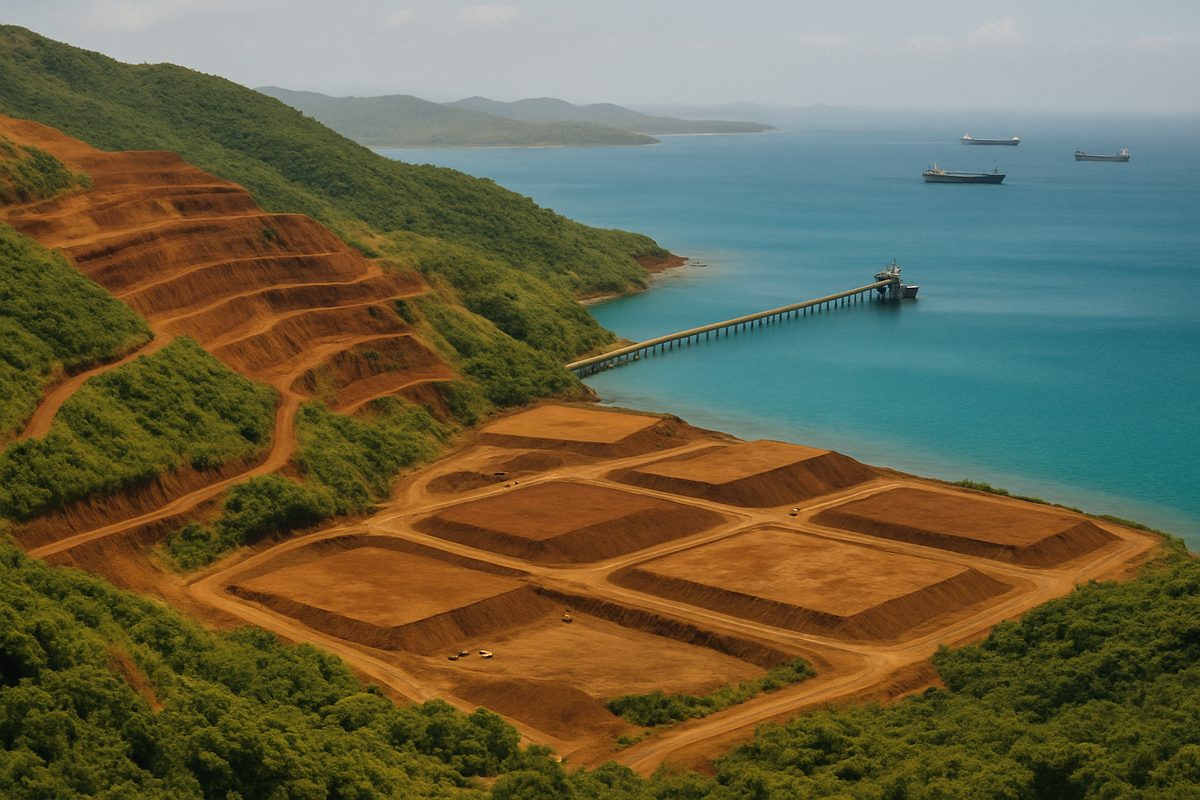
N'Go Bay has concentrated the group's mining activity ever since: the working faces on the heights, the stockpiling platforms, the wharf from which the barges set out and, at anchor, the ore carriers come to collect their cargo. It is within this working landscape that Wakondé takes its place. For the return of the mine was not carried out above local people, but with them.
A company born of the Mont-Dore tribes
Created in association with MKM, Wakondé brings together shareholders mostly from the tribes of Saint-Louis and Île Ouen (the Ouara tribe), at Mont-Dore. Its mission: to handle, under MKM's responsibility, the loading of the ore carriers that come to take away the ore in N'Go Bay.
The choice of these two tribes is anything but abstract: they are the neighbours of the group's mining sites in the commune. It is there that the families most directly concerned by the revival of the activity live, and so it is there that MKM went to find its partners.
The arrangement matters. Local people are not only the neighbours of the mine, nor even mere employees: they are shareholders in the company that carries out the loading. The benefits of the activity come back to them directly, operation after operation, and the business that employs them belongs to them for the most part. Where other models are content to hire locally, this one associates local people with the results of the working tool itself. This choice of local shareholding was not the simplest path; it was the most lasting.
The mining revival of Mont-Dore 'draws on the local communities', NC la 1ère stressed in 2024. This partnership provides daily proof of it: the benefits of the activity go first to those who live near the sites.
Loading an ore carrier, a trade in its own right
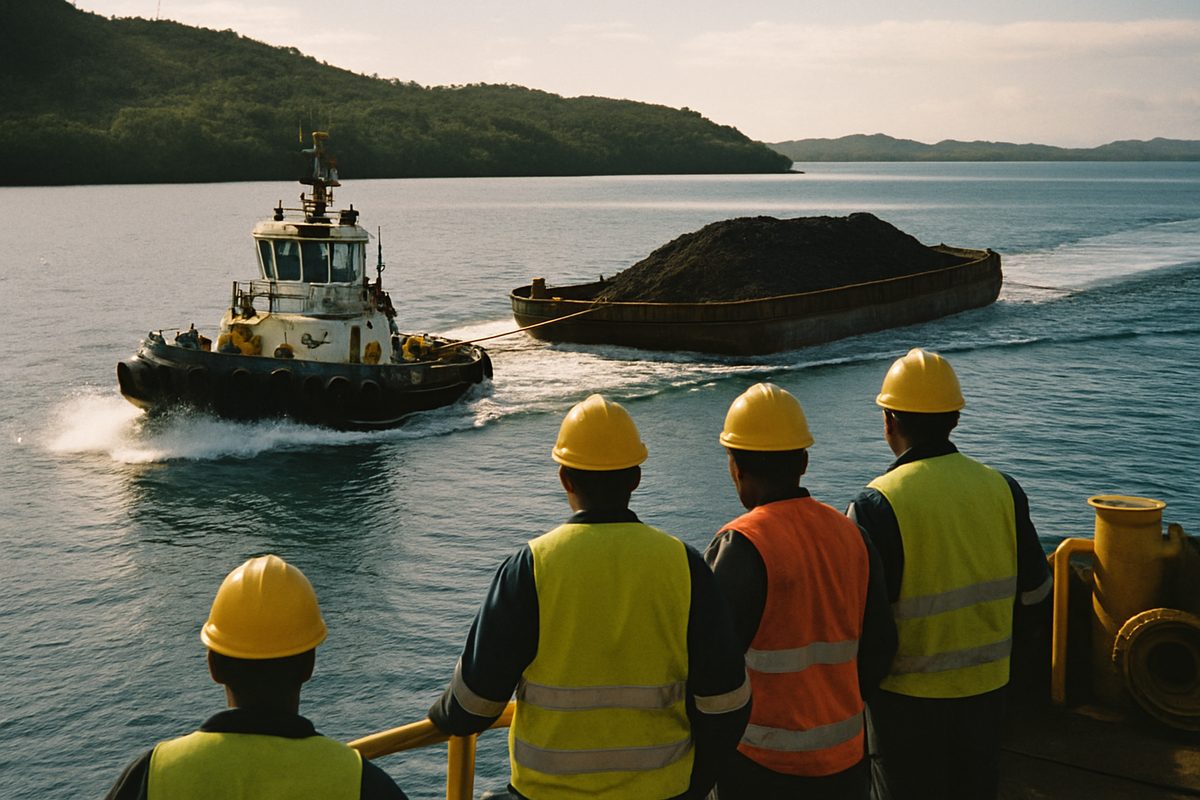
Loading an ore carrier is not improvised. The ore, extracted from the N'Go Bay mines, is carried to the wharf, that reach out over the sea from which the barges are loaded. These barges must then be steered to the vessel anchored in the bay, moored along its hull, the cargo transhipped, then it all begins again, rotation after rotation, until the holds are full.
Mooring services, barging, operation of the shipboard cranes: these maritime skills are an integral part of the group's operating chain, on the same footing as the management of the working faces or grade control. It is within this whole that the Wakondé teams take their place. At each port call, they take part in the loading operations alongside MKM's sailors, in work paced by the barges' rotations and governed by the safety requirements specific to maritime operations.
Ten to fifteen jobs with every vessel loaded
In concrete terms, each ore-carrier loading operation mobilises ten to fifteen casual jobs from Wakondé. Jobs occasional by nature, since they follow the rhythm of the port calls, but which recur with the vessels loaded over the year and represent a regular income for the tribes' families. With each ore carrier announced in N'Go Bay, it is inhabitants of Saint-Louis and Île Ouen who come aboard for the duration of the operation.
These teams work alongside MKM's lighterage operation, which has handled, fully independently, since January 2013, the transport of the ore from the wharf to the ore carrier.
This lighterage operation represents an investment of about one billion CFP francs and relies on substantial resources:
- two 16.5-metre tugboats, Le Jules and L'Émilienne, named in tribute to Jules and Émilienne Mai, the group's founders;
- five 500-tonne barges;
- one 600-tonne barge.
Ten permanent sailors crew them: two captains, two mates, two chief engineers and four deckhands, reinforced by Wakondé's casual workers at each operation.
This mixed organisation has a further virtue: it brings professional sailors and casual workers from the tribes to work side by side, in contact with the tugboats, the barges and the shipboard cranes. Operation after operation, it is concrete maritime and mining experience that is passed on to the commune's inhabitants, and that stays at Mont-Dore.
The scale of the vessels to be loaded gives the measure of the work accomplished. In December 2015, it was the Eternal Triumph, a 55,000-tonne ore carrier, that came to anchor in N'Go Bay for the group's first shipment to China. For the wharf teams, a port call of this scale means a long succession of rotations between the shore and the vessel, down to the last barge transhipped.
The rise of the haulage companies
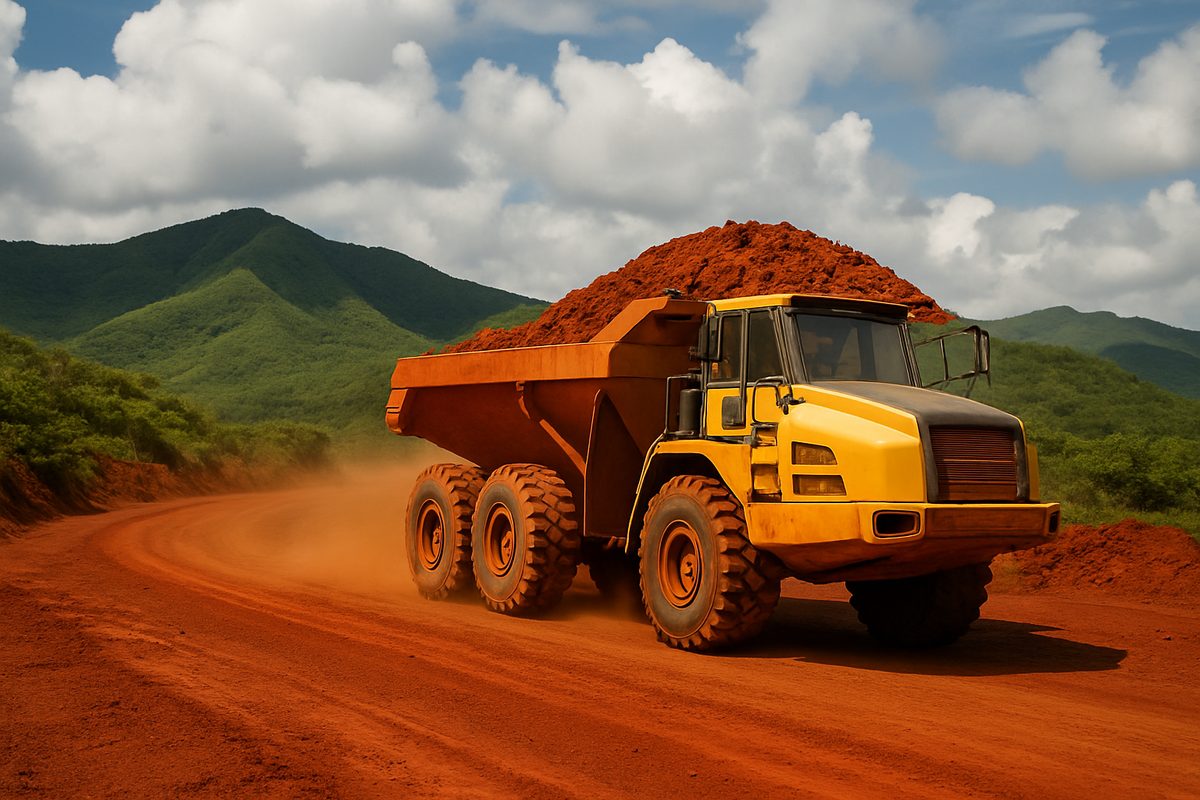
The knock-on effect extends beyond the wharf. Haulage is the transport of the ore on the mine: from the working faces to the stockpiling platforms, then from the platforms to the wharf. An indispensable link in the mining chain, often handled by small independent companies that own their trucks, whose activity depends directly on the vitality of the operations they accompany.
The growth of Wakondé enabled the creation of several haulage companies of this kind. Since 2010, thirteen independent hauliers have thus worked alongside the eighty direct jobs and the score of subcontractors of MKM on the N'Go Bay mines. Fifteen years of continuous collaboration: on a mine, where activity is built over time, this loyalty is an indicator that counts as much as the tonnages. In 2016, the group estimated at about two hundred the number of people living from its mining activity.
For Groupe MAI, seeing these independent hauliers prosper has a particular resonance. The group knows where it comes from: in the 1960s, Jules Mai bought two trucks and worked on the Pentecost mines of Houaïlou. It was through the transport of the ore, prospecting and subcontracting that the family built, step by step, its mining destiny, all the way to becoming a direct operator. To give other haulage entrepreneurs their chance today is to prolong this journey of the haulier turned exporter, unique in the country.
Solid markets, the bedrock of local jobs
These Mont-Dore jobs rest on a simple reality: there have to be vessels to load. And for there to be vessels, there have to be loyal customers, at the end of commercial lines patiently built.
Two ores come out of N'Go Bay. The saprolites are destined for Japan, Korea and the Doniambo plant; the laterites are shipped to China and Australia. In 2013, MKM signed a ten-year contract with Japan's Pamco for 250,000 tonnes per year, 'the company's biggest contract' according to the press of the time. In 2015, it was the only New Caledonian company to obtain the government's green light to export to China; the Eternal Triumph arrived in N'Go Bay at the end of that same year, and exports to Japan and Australia were approved in short order. In 2019, the Conseil d'État definitively confirmed these authorisations.
In 2024, MKM exported 215,000 tonnes of ore to China and Korea. So many cargoes departed from N'Go Bay, and so many loading operations that mobilised Wakondé's casual workers, the lighterage sailors and the mine's hauliers. Every export contract signed by the group translates, at the end of the chain, into hours of work for the people of Mont-Dore.
Local roots as a model
This way of doing things owes nothing to chance. Since its beginnings, the group has cultivated lasting partnerships with customary chiefs, local communities, institutions and the communes near its sites. At Mont-Dore, this commitment has taken many other forms besides Wakondé.
There was first the removal and reprocessing of the old ore stockpiles on the Saint-Louis shoreline, carried out between 2009 and 2011 in partnership with the public authorities and the customary authorities: destocking to recover the material, and redeveloping the freed-up area.
In 2019, MKM signed with the mayor of Mont-Dore an agreement to maintain a section of the Route du Sud. The mines also regularly welcome school groups: middle-schoolers from Auteuil discovered Ada in 2014, pupils visited Graziella in July 2021, with local-press coverage to back it up. Opening the mine to visits is also a way of being accountable, by showing the work as it is done.
The group's solidarity has even reached beyond the country's borders. In 2015, after Cyclone Pam passed over Vanuatu, the Mai family made a tugboat and a barge available free of charge to carry 600 tonnes of donations, including 20 tonnes of rice, and six construction modules to the neighbouring archipelago. 'The Mai family wished to make its contribution,' Christian Taupua explained at the time in Les Nouvelles Calédoniennes of 17 June 2015.
This local anchoring is not unique to Mont-Dore. At Houaïlou, on the East Coast, the SMP is the leading employer in the commune, with its permanent staff, its subcontractors and its casual workers. From one end of the territory to the other, the principle remains the same: the mine must sustain the communes where it operates.
A method proven, year after year
Put end to end, the chronicle of the mining return to Mont-Dore traces a coherent method, in which each step reinforces the previous one:
- 2009-2011: removal and reprocessing of the old shoreline stockpiles at Saint-Louis, with the public authorities and the customary authorities;
- 2010: bringing the Ada mine into extraction and the beginnings of the thirteen independent hauliers of N'Go Bay;
- 2011: Ada's operating order, the official return of mining to Mont-Dore;
- 2013: full independence of MKM's lighterage operation, from wharf to ore carrier;
- 2016: bringing the Graziella mine into operation, on 1 April.
At each of these steps, Wakondé and the tribes' inhabitants have been stakeholders: in the loading of the ore carriers, in reinforcing the crews, in the haulage companies. Local employment did not come along afterwards to soften the mining project; it was, from the outset, one of its building materials.
Direct jobs, casual jobs, haulage companies, community actions: around N'Go Bay, the mine sustains far beyond its own workforce. With Wakondé, Groupe MAI shows that a mining operation can be built with local people, and not simply alongside them.
