

At Groupe MAI, the mines carry first names: those of Jules and Émilienne Mai's daughters for the deposits of the Grand Sud, those of the parents for the tugboats of N'Go Bay. No other player in New Caledonian nickel tells a similar story. This choice says, better than any speech, what the group is: a company where family and work are one and the same. Behind each first name, however, there is far more than a symbol: decades of prospecting, permits patiently obtained, a fleet crewed in-house and a firmly claimed local roots. Here is the story of these names, and of what they commit the group to.
A story born in Kouaoua
In 1956, Jules Mai left Tahiti to join the Kouaoua mining centre, within the Groupe Minier Pentecost. There he was first a storekeeper, then a salesman and manager of the spare-parts store. In the early 1960s, he married Émilienne Tehei Boewa, a native of Nindhia, in Houaïlou. Assigned to the analysis laboratory, he bought two trucks and worked on the Pentecost mines in Houaïlou. Without yet knowing it, the couple thus laid the foundations of a venture that would occupy three generations.
The following years forged the family's expertise. Between 1968 and 1970, Jules Mai delivered 6,000 tonnes of ore enriched to 2.60% and took charge of all Pentecost prospecting. In the 1970s, he led five years of itinerant prospecting across Grande Terre, most often on foot. His children — Wilfrid, Philippe, Noël, Graziella, Mireille, Ada and Nina — grew up to the rhythm of the camps that followed their father's campaigns. Before they ever named mines, Graziella, Mireille and Ada were first the given names of children raised as close as possible to the deposits, in the dust of the mining tracks.
The first name laden with history is, in fact, that of the company itself. When Jules Mai founded his business, he named it Maï Kouaoua Mines: the family name, set alongside that of the mining centre where it all began in 1956. Even before the mines bore the daughters' first names, the company name already carried the memory of the founding place.
From subcontracting to titles held in-house
It was in 1984, after thirty years spent at Pentecost, that Jules Mai created MKM (Maï Kouaoua Mines), at first a subcontractor to NMC. Wilfrid, the eldest, was already working on the mine, which he had joined at barely fifteen; Philippe and Noël joined the group when they came of age; Graziella, Mireille, Ada and Nina all took part in the venture.
The milestones then followed one another steadily: operation of the Sireis mine at Népoui in 1989, as a subcontractor for SLN; creation of Maï Holding Compagnie in 1993; first acquisitions of mining titles at N'Go Bay, in Mont-Dore, in 1994 — the year that also saw the family acquire Pacifique Pneus, a Bridgestone distributor; direct-labour work for SLN on the Kiel Méa mine, in Kouaoua, from 1999 to 2010; creation of the Société Minière de Poro (SMP) in 2000, in Houaïlou; and the formation of the GIE Groupe MAI in 2003.
In New Caledonian mining, a traditional distinction is drawn between the mining contractor, who works a site on behalf of the holder of the mining title, and the direct operator, who works its own titles. The group knows both trades: SMP has operated the Poro mining centre on behalf of SLN since 2000, while the titles acquired in 1994 changed the very nature of MKM. Held in-house, they gave it the status of direct operator: the company runs the whole set of operations, from ore extraction to the loading of the ore carriers. And when it came to naming these Grand Sud deposits, one choice was obvious: they would bear the daughters' first names.
Ada, the return of mining to Mont-Dore
The first is Ada. Prospected in 2008 and 2009, rehabilitated and then brought back into production from 2010 on its South and North plateaus, it obtained its operating permit in 2011. This reopening, prepared between 2009 and 2011 on three concessions south of Plum, marked the return of mining to the municipality of Mont-Dore. "Mont-Dore is looking healthy," headlined Les Nouvelles Calédoniennes on 8 October 2014, just as activity was gathering pace in N'Go Bay.
As everywhere in the New Caledonian massifs, the deposit yields two families of ore: laterites, formed near the surface, and saprolites, deeper and richer in nickel, at the contact with the bedrock. The group's saprolites are bound for Japan, Korea and the Doniambo smelter; the laterites are shipped to China and Australia.
The mine also opened very quickly to the young. From October 2014, students from the Auteuil middle school came to discover mining trades there: "Ada reveals its treasures," the press reported at the time (Les Nouvelles Calédoniennes, 4 October 2014). These school visits would become a group habit. To show the country's children the mine that bears a sister's first name: here, education is also a family affair.
Graziella and Mireille, the sisters of N'Go Bay
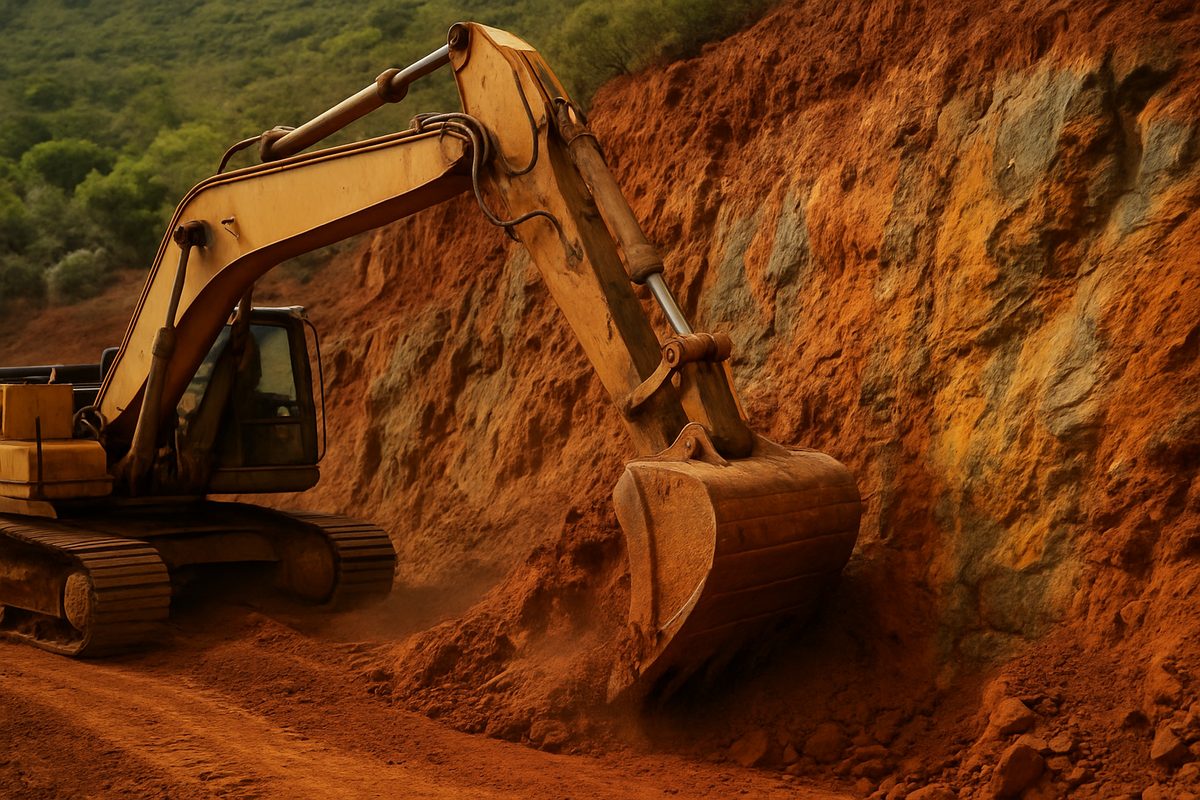
The next stage was being prepared as early as 2011: drilling campaigns refined the potential of two other deposits in the area, named Graziella and Mireille ("Holes in the subsoil," Les Nouvelles Calédoniennes, 11 June 2011). "A mine named Graziella," headlined Les Nouvelles Calédoniennes on 21/05/2015, as the project took shape.
The path of a New Caledonian mine is long and tightly regulated: exploration permit, studies, public inquiry, then an operating permit issued by the authorities — a process detailed on our Mining and sustainable development page. Graziella followed it step by step: the public inquiry conducted in Mont-Dore in 2015 proceeded smoothly, the operating permit was signed on 1 April 2016, and the mine entered production. It in turn hosts school visits, as in July 2021, when pupils came to discover this "mining operation revived in 2016" (Les Nouvelles Calédoniennes, 20 July 2021).
Mireille, for its part, remains at the exploration-permit stage: a reserve for the future that already bears its first name. The three sisters of N'Go Bay thus sum up the three ages of a mine: Ada, confirmed operation; Graziella, production launched in 2016; Mireille, the exploration that prepares tomorrow. Three of the four daughters of Jules and Émilienne thus gave their first names to a Grand Sud deposit.
First names that commit
Giving a mine your daughter's first name is no small thing. It means accepting that the family name will be publicly associated, for decades, with the way the site is worked, maintained and rehabilitated. You do not leave a mountain bearing a sister's name in poor condition. This responsibility, shouldered openly, sets the group apart from anonymous corporate names: here, the operator has a name, a face and an address, in Mont-Dore as in Houaïlou.
The mines' first names are, moreover, those of very real people, involved in the life of the country. As early as 2003, Graziella Mai was treasurer of the Te Tau Tiare association, active notably for the Telethon and World AIDS Day (Les Nouvelles Calédoniennes, 9 March 2003). The company's name also appeared on the roads: from 2008 to 2010, the MKM Trophy rewarded the ranking of the "hot spots" in the Tour of New Caledonia cycling race.
Le Jules and L'Émilienne, the tribute to the founders
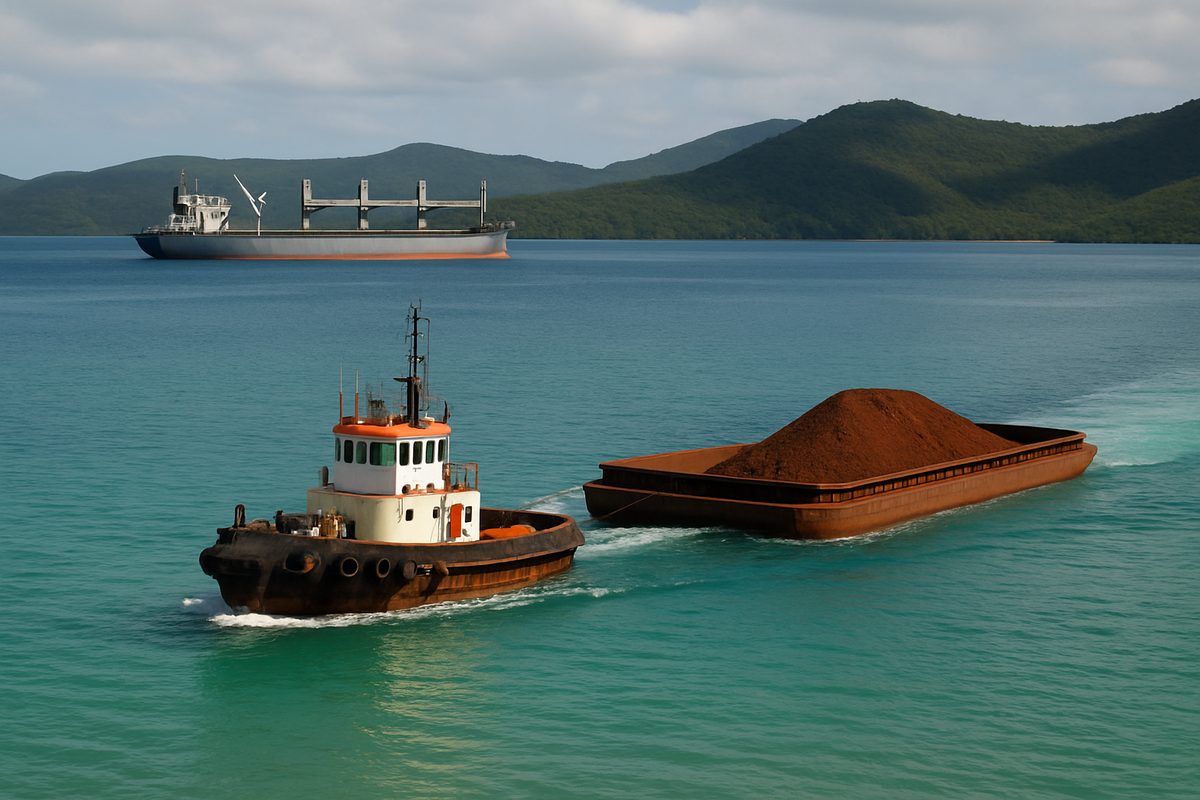
The tradition extends out to sea. Since January 2013, the group has independently handled the transport of its ore between the wharf — the ore jetty from which the loaded barges set off — and the ore carriers anchored in N'Go Bay, thanks to an in-house lighterage operation: two 16.5-metre tugboats, five 500-tonne barges and one 600-tonne barge, an investment of around 1 billion CFP francs. The two tugboats are called Le Jules and L'Émilienne, in tribute to the group's founders.
This fleet supports ten seafarers directly — two captains, two mates, two chief engineers and four deckhands — joined by around ten casual workers during loading. In January 2015, Le Jules and L'Émilienne came together at the Nouméa slipway for their maintenance: the press then had fun with a "traffic jam at the slipway" (Les Nouvelles Calédoniennes, 20 January 2015). Even in the shipyards, Jules and Émilienne travel side by side.
A mine, tribes, a territory
The loading of the ore carriers also mobilises the company Wakondé, created with MKM and whose shareholders are mostly from the tribes of Saint-Louis and Île Ouen. Each operation represents ten to fifteen casual jobs, and the growth of activity in N'Go Bay has enabled the creation of several local haulage companies. In 2014, the press mentioned around 80 direct jobs at MKM; in 2016, the group estimated at 200 the number of people living from mining in the area.
Local roots also run through care for the territory. Between 2009 and 2011, MKM removed and then reprocessed the old ore stockpiles abandoned along the Saint-Louis shoreline, an operation described as "an opportunity […] to redevelop the area" by the group's environmental manager (Les Nouvelles Calédoniennes, 2011). In 2019, the company committed, alongside the Mayor of Mont-Dore, to maintaining a stretch of the southern road. Mines that bear family first names, and that, in return, take on their duties as good neighbours.
Houaïlou, the family loop
There is, finally, an intimate geography in this story of names. Émilienne Tehei Boewa is a native of Nindhia, in Houaïlou; it is in this same municipality that SMP, created in 2000, operates the Poro mining centre on behalf of SLN. The company has become its largest employer, with a little over 66 permanent staff supported by haulage contractors and casual workers, and more than 80 mining machines; in 2022, 420,000 tonnes of ore were loaded there. SLN, on whose behalf SMP operates, is certified ISO 14001 for the environment and ISO 45001 for occupational health and safety; SMP, which works under this coverage and upholds its standards, extends in Houaïlou what the first names say in Mont-Dore: the group works at home, on the lands of its own history.
A story unique in the New Caledonian mining landscape
These first names now accompany the ore to the other side of the world. In 2013, MKM signed a ten-year contract with Japan's Pamco covering 250,000 tonnes per year, "the company's biggest contract" according to the press of the time. In 2015, of four export applications to China, it was the only New Caledonian company to obtain the government's green light; the ore carrier Eternal Triumph, with a capacity of 55,000 tonnes, came to load in N'Go Bay at the end of that same year, while authorisations to Japan and Australia were granted in December 2015, before being definitively confirmed by the Conseil d'État — France's highest administrative court — in 2019. In 2024, 215,000 tonnes thus took to the sea for China and Korea from the mines named after the family.
In New Caledonian nickel, this story is like no other: nowhere else has a family thus given its first names to its mines and its ships. This singularity comes with a motto that has remained intact: "IL FAUT TRAVAILLER!" — "We must work!". Wilfrid Mai, who passed away in October 2024, embodied it for nearly fifty years, from his beginnings on the mine at fifteen to the presidency of the Syndicat des industries de la mine, which he had held since 2013. The tradition, for its part, continues: Jules and Émilienne Mai's grandchildren have in turn joined the group's various companies. Ada, Graziella and Mireille on the mining maps, Le Jules and L'Émilienne on the water: as long as there is ore in N'Go Bay, the Mai family will inscribe its first names there.
